


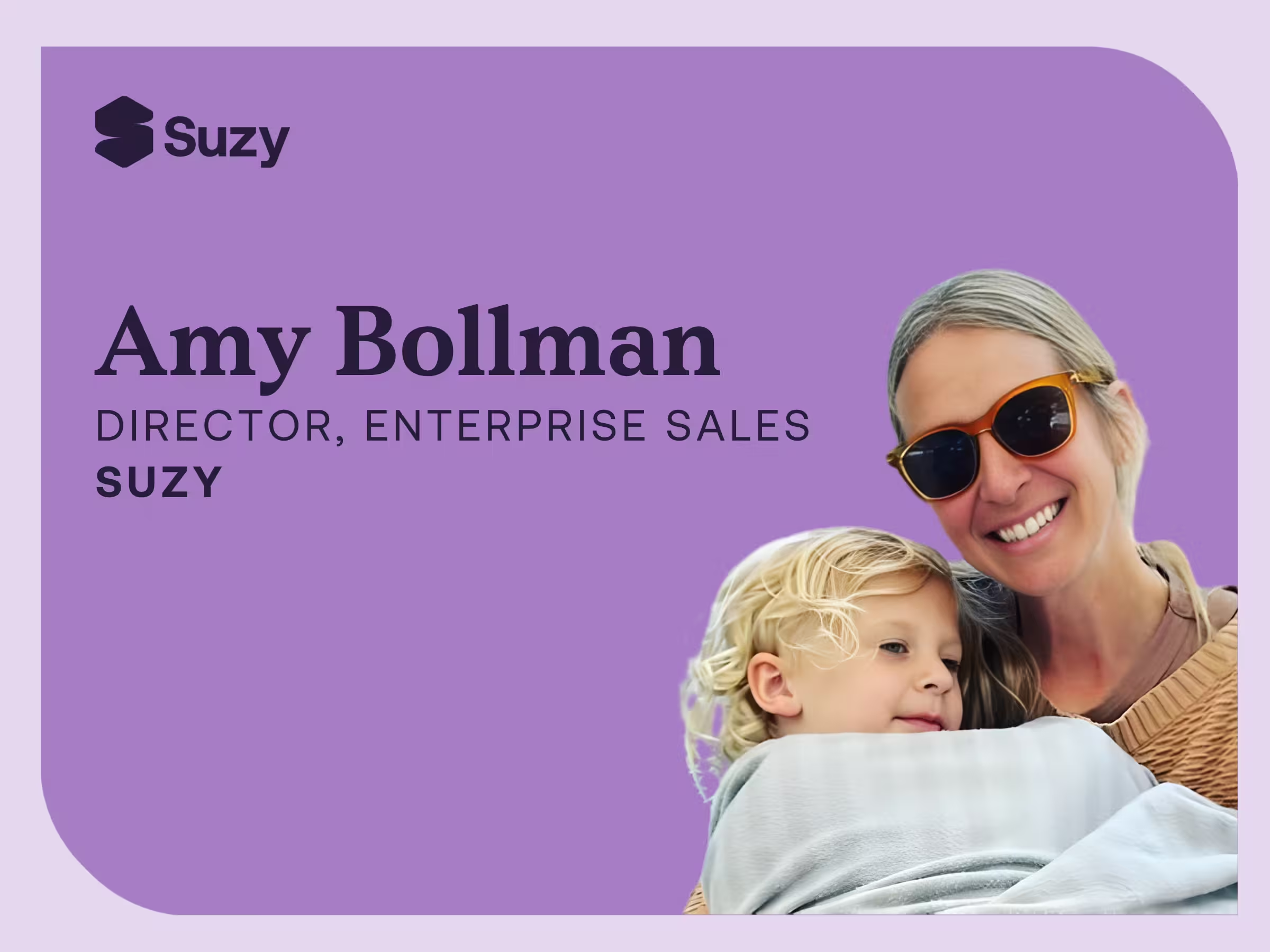

By Amy Bollman, Director, Enterprise Sales at Suzy
Before I became a mom, I thought I understood consumers. After I became a mom, I felt them.
Motherhood didn’t just change my priorities – it rewired how I listen. And that shift reshaped how I think about consumers, brands, and what it really means to understand people. Parenting teaches you quickly that listening isn’t optional. It’s not a soft skill or a nice-to-have. It’s how things work. It’s how trust is built, how conflict is avoided, and how progress actually happens.
And once you experience that kind of listening in your personal life, you start to see just how rare – and valuable – it really is everywhere else.
People don’t always say what they mean
Kids are honest – but not always explicit.
“I’m bored” can mean I need attention.
“I don’t like it” can mean it’s unfamiliar.
A meltdown over the wrong cup is rarely about the cup.
As a parent, you learn quickly that if you only listen to the literal words, you’ll miss the point entirely. You start paying attention to tone, timing, body language, and patterns. You listen for what’s underneath the behavior. You stop reacting and start interpreting. Consumers communicate the same way.
When someone says a product is “too expensive,” it often means they don’t yet see the value. When they disengage, it’s rarely about one interaction – it’s about a pattern of feeling misunderstood, ignored, or disappointed over time. When they say nothing at all, that silence is often the loudest signal.
This is why how you listen matters as much as that you listen.
With tools like Suzy Speaks , brands can hear consumers in their own words, in real time – without forcing responses into rigid surveys or pre-baked assumptions. Suzy’s AI-moderated, conversational research creates space for nuance, emotion, and context, which is where the real insight lives. It allows brands to listen the way parents learn to listen: attentively, openly, and without jumping to conclusions.
Time scarcity changes how decisions get made
Nothing makes you understand time scarcity like becoming a parent. Suddenly, convenience isn’t a bonus – it’s essential. You don’t want more choices; you want clarity. You don’t want to research endlessly; you want confidence. You don’t want to overthink; you want something that works, now.
That lived experience made me deeply empathetic to modern consumers. People aren’t disengaged – they’re stretched thin trying to keep up. Attention is fragmented. Decision fatigue is constant. The brands that win are the ones that respect that reality instead of fighting it.
Listening, in this context, isn’t about long research cycles or waiting weeks for answers. It’s about being able to ask, learn, and respond quickly – before the moment passes.
That’s where real-time insight changes the game. Suzy Speaks allows teams to engage consumers conversationally and get directional, high-quality qualitative insight fast – so brands can move at the same speed their consumers do. It enables responsiveness without sacrificing depth, which is exactly what time-starved consumers – and parents – need most.
Trust is built through consistency, not claims
As a parent, trust is non-negotiable. Children learn to trust when they feel heard and when expectations, rules, and promises are consistently upheld. The moment that consistency breaks, trust erodes.
Brands operate the same way. Trust is built by listening to consumers, following through on commitments, and showing up as a reliable partner. Doing what you say you’ll do is what earns—and keeps—consumer trust.
Trust isn’t built through better messaging or louder promises. It’s built through listening, adapting, and following through. Brands that consistently show consumers they’re being heard earn credibility over time. Brands that don’t quickly feel tone-deaf or out of touch.
By listening continuously – rather than episodically – brands can spot shifts in sentiment early, understand concerns before they escalate, and course-correct before trust erodes. Suzy Speaks helps make that kind of ongoing, human listening scalable, so trust-building isn’t left to chance.
Honesty is the shortcut no one talks about
Motherhood also teaches you something else very quickly: honesty works better than spin. If you have a six-year-old, you learn this daily – sometimes publicly.
My son has no hesitation in telling me when my outfit is “not it.” He will casually inform me that my breath smells right now, often while standing far too close to my face. And once, while climbing into an Uber, he helpfully announced to the driver, “Your car is kind of dirty.”
No whisper. No apology. No awareness of social norms. Just… honesty.
Kids don’t soften feedback. They don’t workshop their phrasing. They don’t worry about how the message will land. They simply state what they observe. And while that level of bluntness isn’t always ideal in adult life, the underlying lesson is powerful: clarity beats politeness when the goal is understanding.
As parents, we learn quickly that avoiding the truth doesn’t work. You can’t explain away something a child has already noticed. You can’t out-spin honest feedback. And if you make a promise you don’t intend to keep, your child will call it out – again and again. Kids don’t want perfection; they want to be heard, and they want consistency between words and actions.
That dynamic mirrors what I learned earlier in my career in sales. The strongest conversations weren’t about persuasion – they were about honesty. About being willing to say, “This may not be the right fit.” About acknowledging limitations instead of glossing over them. Buyers, like kids, don’t trust polish; they trust transparency.
The same principle applies to research. Brands often say they want honest consumer feedback, but their methods don’t always allow for it. Leading questions, overly rigid surveys, or research designed to confirm a hypothesis send the same signal as a parent who doesn’t really want to hear the answer. That isn’t listening – it’s validation. And validation doesn’t build trust; honesty does.
True listening requires creating space for truth – even when that truth is uncomfortable or inconvenient.
Conversational research, like Suzy Speaks, encourages honesty by meeting consumers where they are. It allows people to explain themselves in their own words, to express contradictions, frustrations, and emotional reactions that don’t fit neatly into predefined boxes. And because it happens in real time, it captures feedback before it’s filtered, rationalized, or softened.
Honesty is how brands avoid building the wrong thing confidently. It’s how they reduce risk. And it’s how they earn credibility with consumers who are increasingly allergic to anything that feels scripted or performative.
In parenting, and in research, the lesson is the same:
You don’t need kinder feedback.
You need honest feedback.
Clarity and momentum matter more than perfection
Children are remarkably clear about what matters to them.
They don’t hedge. They don’t overcomplicate. They communicate with urgency and persistence – and they expect a response. They don’t need perfection; they need acknowledgement and movement.
That mindset applies directly to consumers.
They don’t expect brands to get everything right the first time. They expect progress. They want to see that feedback leads somewhere. They want to know their voice had an impact.
Listening loses its power if it doesn’t lead to action. Insight without momentum creates frustration, not trust.
One of the biggest advantages of conversational, AI-moderated research is speed with substance. When insight comes quickly and clearly, teams can move forward with confidence instead of waiting for perfect certainty. Momentum builds belief – internally and externally.
In an increasingly noisy world, listening remains the most underutilized competitive advantage brands have.
Not listening to validate what you already believe.
Not listening selectively.
But listening with humility, honesty, speed, and intent.
What motherhood ultimately taught me about consumers
Motherhood taught me that children, people, HUMANS are complex, evolving, and often surprising. Consumers are no different. When brands take the time to truly understand them – and have the tools to listen well – they don’t just learn.
They earn trust.
They stay relevant.
And they win.
Book a Demo and see how Suzy Speaks conversational research can take your brand to the next level.