


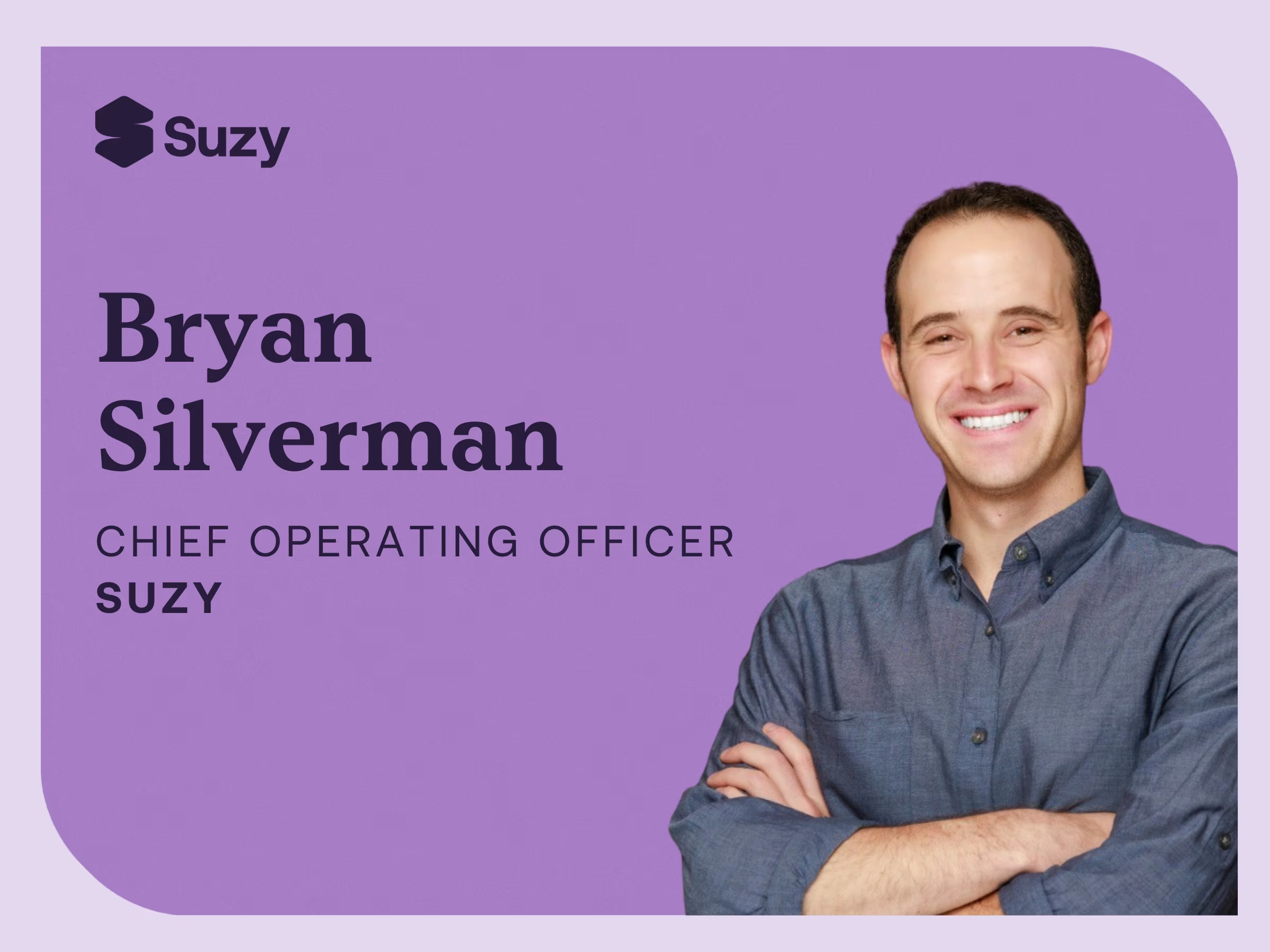

By Bryan Silverman, COO at Suzy
Most leaders today are being asked to make bigger decisions, faster, and with higher stakes than ever before. Pricing shifts. Brand repositioning. Product investments. Market expansion. Organizational change.
These are not incremental optimizations. They are big bets that shape the future of a business.
Yet many of these bets are made with less confidence than leaders would like. Not because data is unavailable, but because the context around that data is incomplete, fragmented, or missing altogether.
Across the companies we work with, we see teams moving quickly – but without a shared understanding of what the information actually means. Research exists, but it lives across decks, tools, teams, and moments in time. By the time leadership is asked to decide, much of the nuance and reasoning behind past learning has thinned out or disappeared.
In moments of transformation, the biggest risk isn’t that companies fail to change. It’s that they change repeatedly without conviction. Big bets require clarity, alignment, and context that holds as decisions move from idea to execution.
How context gets lost inside modern organizations
Most organizations do not lack research. They lack continuity.
Research is often treated as a point-in-time activity. A study is run. A deck is delivered. A meeting happens. Then the organization moves on. When related questions resurface weeks or months later, the original assumptions, tradeoffs, and emotional nuance are no longer visible.
Context erodes through handoffs:
- A finding becomes a slide.
- A slide becomes a talking point.
- A talking point becomes a vague recollection.
When that happens, teams default to instinct or partial information. Decisions still get made, but confidence erodes. Alignment weakens. Execution becomes fragile.
Big bets rarely fail because they were unreasonable. They fail because the organization never shared a clear understanding of the problem being solved.
The real bottleneck is not insight generation alone – it’s insight continuity
Many teams already have the answers “somewhere.”
Marketing, insights, and strategy teams often sit on years of learning: trackers, concept tests, qualitative interviews, segmentation work, trend analysis. But when decisions need to be made quickly, that knowledge is hard to assemble in a usable way.
This creates familiar friction:
- Research teams are pulled into constant reactive requests
- Stakeholders wait for answers they believe already exist
- Leadership feels decisions take longer – and carry more risk – than they should
The result is not paralysis, but hesitation. Teams hedge. Bets get smaller. Transformation becomes exhausting instead of energizing.
This is not a failure of effort or expertise. It is a failure of context flow.
What happens when context disappears: decisions restart from scratch instead of building over time
When context is missing, teams jump to solutions before problems are fully understood.
New tools are adopted. New processes are rolled out. New workflows are introduced. While these changes can help, they rarely address the root issue: teams are no longer grounded in a shared understanding of what problem they are solving or what assumptions decisions are built on.
When assumptions drift or remain implicit, every decision feels new. Every shift feels risky. Progress resets instead of compounding. Teams confuse motion with progress and react to noise instead of signal.
Context is what allows decisions to build on one another rather than restart from scratch.
The missing insight: teams need two distinct kinds of context
Most organizations treat “context” as a single thing. In practice, teams need two different but complementary forms of context to place strong bets.
External context: what’s happening in the market right now
This includes cultural shifts, emerging behaviors, sentiment changes, and early signals that shape how decisions should be framed today.
Internal context: what the organization already knows
This includes prior research, tested assumptions, customer language, tradeoffs, and the reasoning behind past decisions.
When either type of context is missing, decisions weaken. When both are present – and shared – teams move faster with more confidence.
How Suzy restores context across both dimensions
This is the problem Suzy is designed to solve.
Signals: shared context about the market and culture
Signals provide always-on, hyper-personalized trend intelligence that helps teams stay grounded in what’s changing across consumers, categories, and culture. After you run research or as market conditions evolve, Signals surface the shifts most relevant to your role, your industry, your company, and your goals.
Signals give teams a continuous read on the external conditions shaping decisions – before assumptions harden and before outdated context drives strategy. They answer the question: what’s changing right now that should frame this decision?
Stories: shared context about your research and decisions
Stories preserve internal context by transforming your research into durable, stakeholder-ready deliverables. Stories instantly turn research findings into easy-to-comprehend infographics and insights summary decks – delivered in your brand look – saving teams time and effort while ensuring clarity and consistency.
Beyond format, Stories capture and retain meaning. They include high-level takeaways, strategic implications, and recommendations for next steps, helping teams understand:
- What was learned
- Why it mattered
- What assumptions were tested
- What decisions the research should inform
Instead of insights living and dying in decks, Stories keep learning connected, accessible, and reusable.
Together, Signals and Stories create continuity. They allow organizations to move quickly without losing alignment – and to place bigger bets without losing confidence.
Why context is a strategic advantage in today’s environment
The pace of business is accelerating. Consumer expectations shift quickly. Competitive advantages erode faster than they used to. Leaders are asked to decide with imperfect information more often.
In that environment, context becomes a strategic asset.
Organizations that preserve and reuse customer learning – and the context behind it – place better bets. They move faster without fragmenting alignment. They replace constant reinvention with informed iteration.
Transformation becomes steadier and less exhausting.
Conclusion: big bets succeed because teams are clear, not just bold
Big bets in business transformation succeed not because leaders take bigger risks, but because they maintain clarity as decisions evolve.
Clarity comes from shared context – about the market, about the customer, and about what the organization already knows. When that context is accessible and connected, decisions feel deliberate instead of reactive.
This is the problem Suzy focuses on solving today.
If you’re exploring how to bring real consumer context into your most important decisions, Signals and Stories can help you get there.