


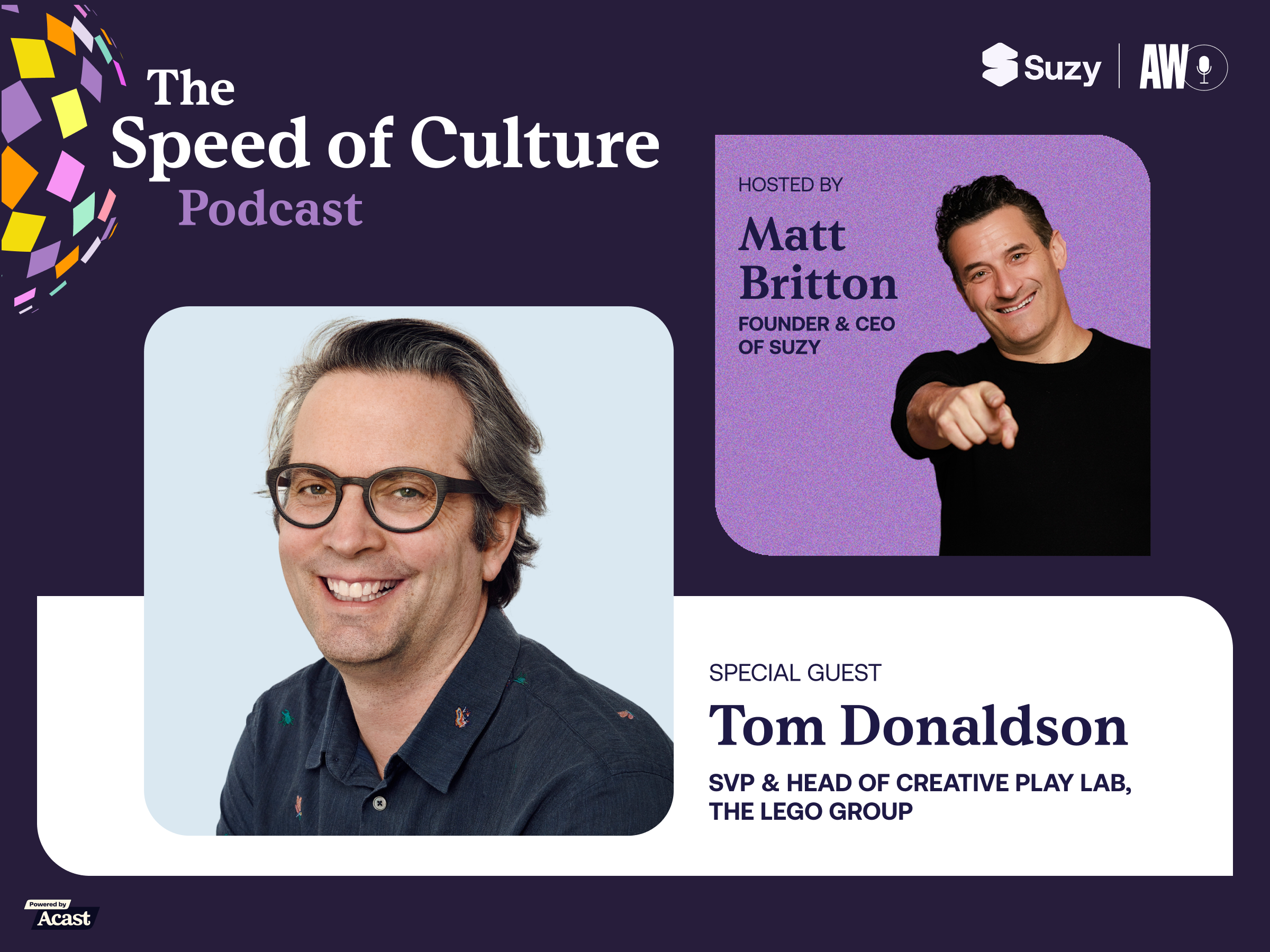

“Magic works in lo-fi.” – Tom Donaldson
Play has always been physical, social, and imaginative. Yet as technology continues to shape how children grow, learn, and interact with the world, brands face a difficult balance. How do you evolve without replacing what already works? How do you add capability without removing agency?
That tension sits at the center of this episode of The Speed of Culture podcast, where Matt Britton speaks with Tom Donaldson live from CES 2026. As Senior Vice President and Head of Creative Play Lab at the LEGO Group, Tom offers a rare look into how LEGO approaches innovation, leadership, and creativity at scale, starting with the launch of LEGO SmartPlay at CES 2026.
Tune into the latest episode or read the transcript below to learn more. Here are some top takeaways:
LEGO SmartPlay Is an Expansion, Not a Replacement
Tom is deliberate with his language. LEGO SmartPlay is not framed as a reinvention or a shift away from traditional play. He calls it a new dimension added to the LEGO System in Play.
Bricks remain bricks. Building remains the starting point. Imagination stays in the hands of the child. What changes is that models can now respond. They can react to movement, proximity, and interaction in ways that feel physical and immediate.
Tom compares this moment to the introduction of the LEGO Minifigure. Minifigures did not change how bricks worked. They added roleplay and narrative on top. SmartPlay follows the same logic. It layers responsiveness onto existing play rather than redefining it.
That distinction explains why the LEGO Group chose CES for the announcement. This was not a single set launch. It was the introduction of a platform mindset.
Inside the LEGO SMART Brick
At the center of LEGO SmartPlay sits the LEGO SMART Brick. On the surface, it looks like a familiar 2x4 brick. Inside, it carries sensors, accelerometers, light sensing, audio, and a miniature speaker powered by an onboard synthesizer.
Tom explains that the brick detects how a model moves, what elements are nearby, and how different pieces interact. Push a vehicle faster and the sound changes. Skid around a corner and the feedback shifts. Place elements together and behavior evolves.
What stands out is not the technology itself, but what the LEGO Group chose not to include. No screens. No instructions telling kids what to do next. The experience remains physical and exploratory.
This is interactive LEGO play without screens, where feedback responds to curiosity rather than directing it.
LEGO R&D Product Development Built Brick by Brick
The R&D product development behind LEGO SMARTPlay unfolded over many years. Tom describes a process that included constant testing with kids, as well as extended in-home trials where families played without supervision for months at a time.
These tests were not about validating assumptions. They were about observing behavior. How do kids return to a set after a day away? What do they try again? What surprises them? What gets ignored?
Conviction did not arrive through a single breakthrough moment. It grew slowly through early demos that showed just enough magic to believe in, followed by steady validation across technology, play value, and business reality.
As Tom puts it, conviction was built brick by brick.
Creativity and AI Leadership With Humans at the Center
When the conversation turns to creativity and AI leadership, Tom avoids extremes. He does not position AI as a threat or a savior. He sees it as access. Access to shared human knowledge, patterns, and tools.
As predictable tasks become easier to automate, creativity increases in value. But creativity does not become writing prompts and walking away. Tom argues that attention to detail matters even more. Judgment matters. Taste matters.
AI can shorten the loop between idea and execution, allowing people to make and refine faster. What remains human is deciding what is worth making in the first place.
In Tom’s words, the future looks less like replacement and more like everyone becoming a better creative director.
Leadership Means Committing Before Outcomes Are Clear
Asked what he looks for in future leaders, Tom points to three qualities that repeatedly show up in the work.
Curiosity beyond your own field. Resilience built through uncertainty. Values that guide decisions when success is not guaranteed. Strong R&D product development depends on collaboration across disciplines. The most interesting ideas emerge when people stay curious about domains they do not fully understand.
Resilience shows up in the willingness to invest months of work knowing it may not survive intact. Tom describes this willingness as a superpower. Not blind optimism, but informed commitment.
Leadership, in this context, means creating environments where that kind of work feels possible.
Why LEGO Believes “Magic Works in Lo-Fi”
Tom closes the conversation with a phrase that captures the LEGO brand’s philosophy toward innovation. “Magic works in lo-fi.”
The earliest version of an idea does not need polish. It needs belief. Cardboard prototypes, post-it notes, and rough demos often reveal whether something holds promise. When teams can feel the magic early, even when others cannot yet see it, they gain the conviction needed to carry ideas through difficult phases.
This mindset applies far beyond toys. It speaks to leadership, creativity, and how meaningful work takes shape.
What This Means for Leaders and Builders
This episode offers more than a product announcement. It provides a grounded view into how innovation survives inside a global brand.
The lessons are clear:
- Progress comes from layering, not replacing.
- Play thrives when imagination stays in control.
- R&D product development rewards patience and listening.
- Creativity and AI leadership work best when humans stay at the center.
- Conviction grows through early belief and sustained effort.
For anyone building products, teams, or creative cultures, this conversation offers perspective without hype.