


The 50% Awareness Problem: What Hollywood Teaches Marketers About Earning Attention
Once upon a time in Hollywood, mass awareness was guaranteed. Studios bought television spots around the shows everyone watched, audiences sat through the commercials, and a major movie could head into opening weekend with more than 90% awareness.
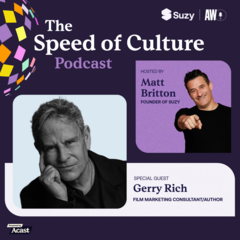
That world has disappeared. Today, Gerry Rich says studios can be hard-pressed to reach 50-60%, even with dramatically better targeting, more data, and more channels at their disposal.
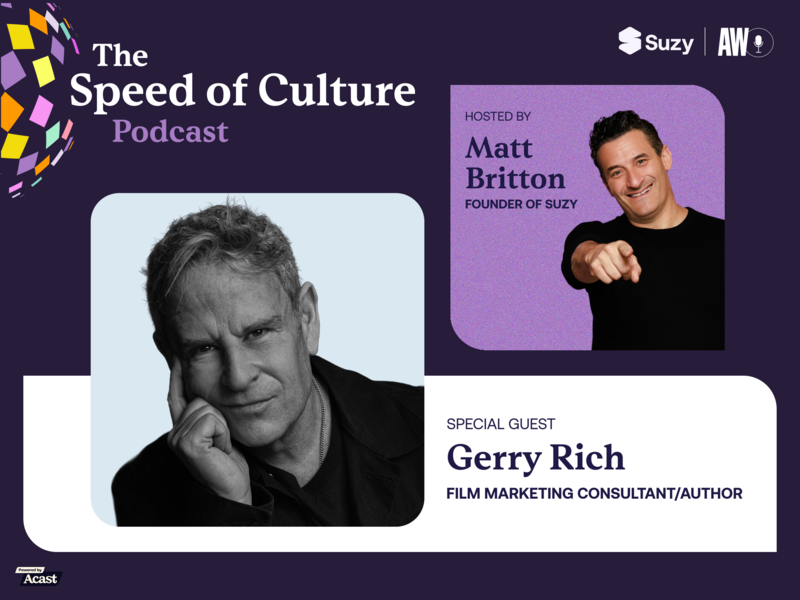
That contradiction sits at the heart of his conversation with Matt Britton in the latest episode of The Speed of Culture Podcast.
Today, Every Impression Has to Work Harder
Linear television offered Hollywood something modern media rarely can: forced viewership at scale. Audiences watching the biggest shows saw the advertising placed around them because there was no skip button waiting around the corner.
Digital media replaced that certainty with choice. Consumers now move across platforms, content and devices at will. So, the job changed. Getting in front of someone is no longer the finish line. The creative now has to give them a reason not to move on.
The First Trailer Matters More Than Ever
That reality makes the first trailer of any project particularly important. Gerry goes so far as to say that it will typically be the piece of marketing that reaches the largest audience. By the second trailer, viewership can fall 50-70%. It’s also critical to note that you do not get unlimited attempts at the same first impression, so movie trailers have to be tested as rigorously as they are today (we’re talking months of testing).
The challenge is balance. Reveal too little and people are confused. Reveal too much and they feel as though they have already watched the movie. According to Gerry, the strongest trailer gives audiences enough information to understand the premise without satisfying their curiosity completely.
And, that rigor feels increasingly relevant outside Hollywood too. In a fragmented media environment, launch moments carry disproportionate value.
A View Is Not the Same as Attention
But the plot thickens because even a huge trailer launch can create a misleading sense of success. Gerry gives the blunt example of a piece with 50 million views but only a thousand conversations, engagements and shares. His conclusion is blunt: you bought views.
The better signal, and the one every marketer (film or not) should be using is what people do next:
- Do they share?
- Do they comment?
- Do they talk about a character?
- Does a moment from the trailer start traveling organically?
Modern film campaigns can then use social listening to identify what audiences are reacting to and shift subsequent messaging around it. That is the advantage of digital media at its best - you may have lost guaranteed reach, but you also gained the ability to hear the audience answer back.
Originality Gives Younger Audiences a Reason to Show Up
That feedback becomes especially important with Gen Z. Gerry does not believe younger audiences have abandoned long-form movies or the theatrical experience. In fact, his argument is almost the opposite. They will show up when the experience feels worth showing up for.
He points to younger audiences embracing original films and the communal appeal of genres such as horror. Watching something with 200 strangers creates an experience streaming at home cannot fully replicate.
But Gen Z is also ruthless about rejecting work that feels familiar for the sake of familiarity. Gerry believes originality still matters precisely because younger consumers have become so good at recognizing formulaic work.
Star Power Now Includes the Relationship With the Audience
Interestingly, the same shift has changed what “star power” means. Studios still care about acting talent and traditional fame. But today, digital footprint has been added to the list. Gerry says an actor’s social reach now comes up in greenlight conversations because that audience can give a film an immediate distribution advantage.
But follower count alone is not enough. He points to Zendaya as someone who uses social media with unusual discipline: she lets fans into her world without making every interaction feel like studio marketing. During Challengers, Gerry watched that relationship become a major campaign asset as Zendaya promoted the film across a six-country tour. The value was not simply that she had an audience. It was that the audience trusted the relationship.
Scale Can Make Great Marketing Harder
The conversation zooms in on an all-too-familiar concept in filmmaking today: volume. Getting a viewer into a theatre seat requires trust and attention, which in turn requires care. And, that is why Gerry is skeptical of the entertainment industry becoming too focused on volume.
Every movie requires work before, during, and after production. Then the marketing team has to find the right message, watch audience reaction in real time, and keep adjusting ahead of opening weekend. Do that across too many films and the system starts to strain. The largest franchises and filmmakers command the attention they need, while the films in the middle compete for internal bandwidth, release dates, trailers, media, and leadership focus.
Something eventually gives, and Gerry believes that something is often quality. The warning applies to any marketing organization under pressure to produce more content simply because the technology makes more production possible. More output is useful only if the rigor survives it.
AI Should Remove Friction, Not the Human Voice
AI adds another layer to that tension. Gerry points to some obvious opportunities behind the scenes - it can help reformat trailers and short-form assets for multiple platforms, lower production costs, sharpen targeting and make campaign execution faster. Those are practical improvements.
His concern begins when audiences can feel the shortcut. Young consumers in particular are already looking for authenticity. So, if technology makes the story seem cheaper, less human, or disconnected from an artist’s point of view, the cost saving may create a larger creative problem.
Gerry compares the opportunity to visual effects. Technology works when it improves immersion and helps deliver the experience. It becomes a problem when the audience notices the technology instead of the story.
Breaking Through Now Has to Be Earned
The mass-reach era made attention easier to buy. The fragmented era makes attention something marketers increasingly have to earn. That explains why so many of Gerry’s lessons lead back to the same qualities: understand the audience, protect the first impression, study genuine response, keep the work original, and refuse to let scale replace rigor.
The tools will keep changing, the channels will keep multiplying, and AI will make production faster. But none of that eliminates the central marketing problem of making people care. When the audience can leave with one swipe, skip, or click, giving them a reason to stay may be the most valuable creative advantage a brand can have.