



When Information Is Everywhere, Connection Becomes the Luxury
For decades, luxury real estate has followed a certain set of rules: A bigger home, a more exclusive address, a higher price.
But today, those signals are becoming less useful for understanding why affluent consumers actually choose one thing over another.
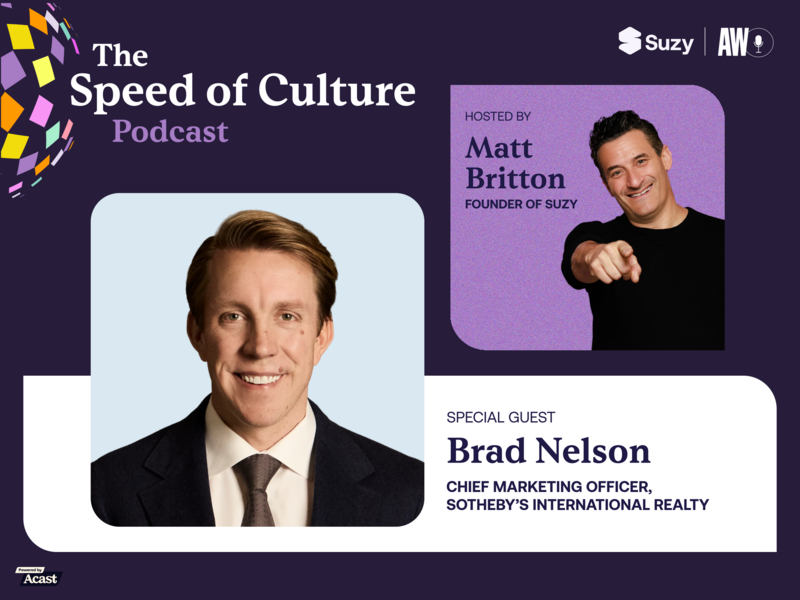
On the latest episode of The Speed of Culture Podcast, Matt Britton sits down with Brad Nelson, Chief Marketing Officer at Sotheby’s International Realty, about how the definition of luxury is changing. Across 50 years of brand history, one idea has remained surprisingly consistent: the strongest value often comes from what cannot be reduced to a price tag.
What Makes Something Distinct? That’s Luxury.
Brad believes one reason Sotheby’s International Realty has stayed relevant is that it has never tried to be everything to everyone. The brand focuses on properties that are distinctive and high quality, regardless of where they sit on a price scale.
And, that distinction matters because two homes can be on the same street and carry dramatically different values because of something as specific as ocean frontage. Price reflects part of the story, but it does not explain what makes the property meaningful.
For marketers, the principle travels well beyond real estate. When a category gets crowded, broad appeal can become tempting. But longevity often comes from being clearer about what makes the brand worth choosing in the first place.
The New Buyer Philosophy: Lifestyle Before the Home
In fact, Brad says that clarity matters even more because the consumer has changed.
He describes an affluent buyer who is less interested in using the home purely as a visible status symbol and more interested in what the property allows them to do. Millennials grew up watching HGTV and imagining how spaces could shape their lives. Today, that shows up in practical decisions.
A Wall Street professional may choose Brooklyn over Westchester because a shorter commute matters more than extra space, while a weekend buyer may prefer the Hudson Valley or Berkshires because getting there feels easier than sitting in traffic toward another destination.
The purchase follows the lifestyle. And, this principle impacts the marketing too.
The most useful story is no longer simply about bedrooms, acreage or price. It is about what life looks like once the buyer gets there.
Information Has Changed the Advisor’s Role
The conversation also pivots to the interesting shift in the role of an advisor.
Twenty years ago, Brad points out, Zillow did not exist, and newspaper advertising remained a primary way to discover homes. Now, consumers can access more information than they could realistically process.
So, the advisor no longer wins simply by possessing information the buyer cannot find. The value comes from helping the client interpret it:
- Which property matters?
- Which market signal is meaningful?
- Which trade-off is worth making?
As information becomes abundant, curation becomes more valuable.
That is one reason Sotheby’s looks closely at what its advisors are seeing on the ground. Its Luxury Outlook research gathers both qualitative and quantitative feedback from advisors active in $10 million-plus transactions. That approach helped the company identify renewed momentum in San Francisco before the shift became obvious in broader sales data.
Digital Presence Builds Trust Before the Buyer Arrives
Brad also hones in on how the same dynamic is reshaping media.
New wealth is increasingly being created among younger consumers, so luxury brands cannot wait until those people become active buyers to start building relevance.
Brad says Sotheby’s International Realty has invested over time in building large audiences on YouTube and Instagram. But he also makes an important distinction; while digital channels influence how future clients think about the brand before they interact with it, they do not necessarily close the decision.
When someone is preparing to make a multimillion-dollar purchase, they still often ask a financial advisor, attorney, parent or mentor who they trust. So, the rule is:
- Social builds familiarity
- Referral reduces risk
The Real Product Is Often the Network
That insight leads directly into Sotheby’s “Well Connected” campaign.
Brad tells the story of Martha Turner, an advisor in Houston who received an opportunity involving a property in rural Provence. At first, the location sounded difficult to service. Then came the detail that changed everything: it had been Julia Child’s house. The network took over; Martha was connected with the right advisor in the south of France, Sotheby’s PR team became involved and the property gained international attention and sold successfully.
The point is larger than the listing. Martha could create value for a client thousands of miles away because she had access to the right people. That is what Brad means by being “well connected.”
AI Makes the Human Connection Much More Valuable
The campaign also arrives at an interesting moment where AI is making information faster to generate, easier to find and increasingly available to everyone.
Sotheby’s response is not to pretend that technology does not matter. It is to recognize what becomes more valuable because of it. Because when information is scarce, access is the advantage. And, when information is everywhere, judgment becomes the advantage (along with trust and knowing who to call).
Brad describes human connection as a potential defining marker of real luxury for precisely that reason. Technology can surface options, but it’s the relationship that helps someone decide what those options mean.
The Relevance Secret: Understanding What Should Not Change
Sotheby’s International Realty has spent 50 years operating through enormous shifts in media, wealth, technology and consumer behavior. The buyer has changed, the channels have changed, and the markets themselves continue to move.
But the strongest thread through Brad’s conversation is that relevance does not require replacing everything that worked before. It requires understanding what the consumer now values, and translating the brand’s strengths into that context.
For Sotheby’s, that means moving from:
- Status toward lifestyle
- Information toward interpretation
- Reach toward credibility
- Access toward connection
The next avatar of luxury is less about having more, and more about knowing who and what to trust.