


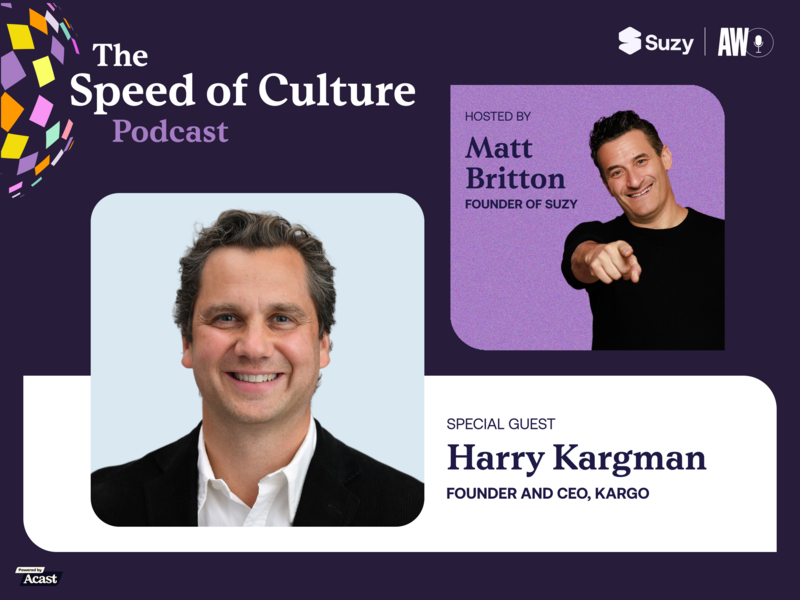

Wait for the Signal: What 23 Years of Reinvention Taught Kargo About Moving Fast
Marketing has a speed problem. The industry rewards being early, every new platform arrives with pressure to test it, and every technology shift creates a new reason to worry that someone else is moving faster.
But speed without a signal can become expensive guesswork.
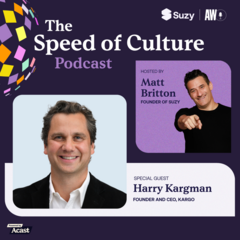
Harry Kargman has spent 23 years building Kargo through some of the advertising industry’s biggest shifts, from mobile and the open web to social, CTV, privacy changes and now AI. On The Speed of Culture Podcast, he tells Matt Britton that staying relevant has required something more nuanced than simply moving fast.
Start by Respecting How Quickly the Market Can Change
When Kargo launched in 2003, Facebook, Instagram and YouTube had not yet become the forces marketers know today.
The company began with mobile advertising, building creative formats across major publishers and over time, expanded into social and eventually connected TV.
Harry does not describe that evolution as a neat long-term plan. Instead, Kargo operates with what he calls a “healthy respect” for the possibility that the market can change underneath the business. That mindset creates a different question - instead of asking whether the current model still works today, ask what could make it stop working tomorrow.
For a company operating in advertising technology, that question never stays theoretical for long.
The Netflix Moment: Hype Is Not the Same as a Signal
Harry’s approach to CTV captures this distinction perfectly, actually.
He was firmly against entering the category, even when industry peers kept telling him the audience was moving there. And, he agreed. But his problem was that Netflix, Disney, and Amazon, the platforms with much of the premium content, did not carry advertising.
So Harry chose a specific trigger: if Netflix launched advertising, Kargo would enter CTV.
Once Netflix announced an ad-supported tier, Kargo moved.
Harry says the CTV business that did not exist three years earlier is now expected to generate roughly $100 million this year. The lesson here is useful far beyond connected television. Marketers are constantly told a platform or technology is “the future.”
The better question may be: what would have to happen for us to know the future has actually arrived?
A Pivot Only Works if the Team Moves Too
Speaking of signals, Harry makes one thing clear. Spotting them is one thing but getting an organization to act on them is another.
Harry admits that people naturally resist change. So, Kargo’s response has been to make reinvention part of the company’s identity. There is artwork in its office featuring a cracked, bandaged arrow and the words “pivot, pivot, pivot.”
But the more important tool is storytelling.
When a pivot succeeds, Harry retells the story.
That way, the next shift does not feel like management suddenly asking everyone to abandon the plan. It becomes another version of something the organization already understands: the market moved, Kargo recognized it and the company changed with it.
New Channels Don’t Always Need New Creative
Harry also makes the valuable point that adaptation does not necessarily mean starting from zero.
Kargo’s approach to CTV creative is a good example. Harry sees little value in simply taking the same linear television commercial and putting it into a connected TV environment.
Instead, Kargo has been taking creator content that already performs well on platforms such as TikTok, YouTube and Instagram, reformatting it for a television screen, and extending it through CTV placements.
The advantages are straightforward:
- The creative has already faced the consumer and already has evidence behind it
- Brands can keep refreshing their CTV library using content being produced elsewhere instead of waiting for another dedicated production cycle
So, the channel may change, but the useful signal from the consumer does not have to disappear with it.
AI Changes the Interface, Not the Need for Infrastructure
Harry also pulls the curtain back on Kargo’s latest AI venture: Karlo.
Harry describes it as an AI-powered media buying platform where users can add creative assets, brand guidelines, audience information, contextual requirements and campaign plans, then interact with the system conversationally.
Now, that simplicity may be the visible part, but the less visible part took 23 years.
Kargo has spent decades building relationships and technical integrations across publishers, social platforms and CTV environments. Harry’s argument is that AI can now make that infrastructure easier for more people to use.
Today, much of Kargo’s white-glove service goes to large advertisers. On the other hand, Karlo is intended to open more of that access to mid-market brands and agencies that do not have the same resources or complexity behind their media buying.
The bigger takeaway here is that AI may make the experience feel instant. The capability underneath it was anything but.
Long-Term Change Still Happens Brick by Brick
Harry closes the conversation with three ideas he believes have sustained Kargo.
- Accept that you will not get everything right the first time
- Be willing to pivot when the market changes
- And maintain enough optimism to believe there is a way forward
But underneath all three is another standard: progress has to be visible.
Harry wants to see movement week by week, and month by month, which is a useful counterpoint to an industry obsessed with sudden disruption.
The biggest changes often look sudden only from the outside. Inside the company, they were being built slowly.
Moving Fast Starts With Knowing What You’re Waiting For
Kargo’s history may be full of pivots, but Harry’s story is not really an argument for reacting faster to everything. It is an argument for becoming clearer about what deserves a reaction.
Privacy changes created new reasons to think about context, social media created a library of proven creative that could move onto bigger screens, Netflix advertising created the signal for CTV, and AI now creates an opportunity to put decades of media infrastructure behind a simpler interface.
Each shift is different but the discipline underneath them is the same:
- Know what could change your market
- Decide which evidence would prove that change is real
- And when the evidence arrives, be ready to move