



The Product Is the Channel: How Fanta Transcends the 30-Second Spot
There was a time when marketers could shape almost everything people thought about a brand with one 30-second commercial. Ibrahim Khan thinks the industry is still recovering from how easy that made things.
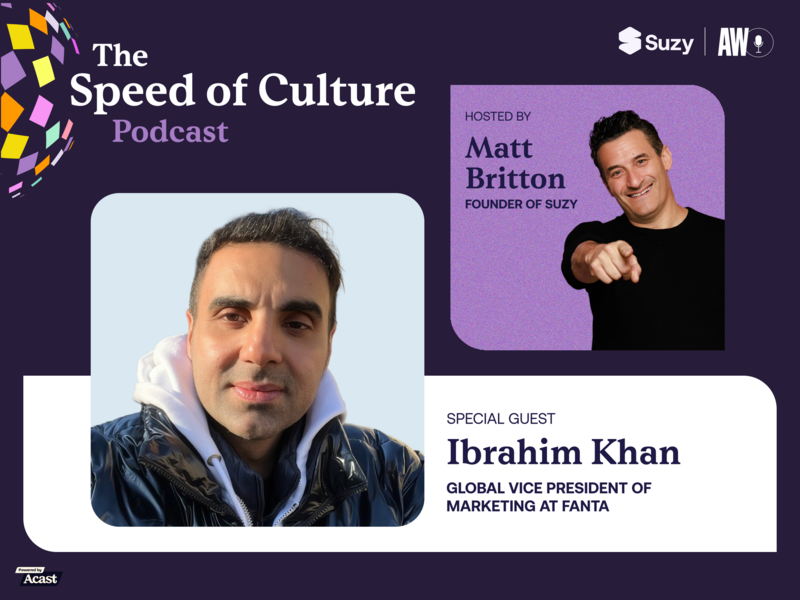
On The Speed of Culture Podcast, Fanta’s Global Vice President of Marketing tells Matt Britton that today’s marketer has to think much bigger than communication. The product, packaging, retail environment, live experience, and what consumers say afterward all contribute to the brand.
His point is simple: consumers hold the microphone now.
Keep the Truth, Change the Expression
Managing a global brand throws up an immediate dichotomy: how much should stay consistent and how much should bend to local culture? Ibrahim believes the fundamental reason someone chooses a brand often travels surprisingly well. Fanta is built around refreshment and fun, and that principle does not need to be reinvented in every country. How those qualities come to life and are expressed, absolutely does.
Consumption occasions differ, language matters, and retail environments vary dramatically. Ibrahim recalls initially wanting to simplify visually crowded stores in Asia before realizing that the aesthetic matched what consumers there expected.
Cultural Relevance Needs a Reason
That discipline also shapes which cultural moments Fanta enters. Ibrahim puts it bluntly: not every festivity needs a brand, and not every brand needs a festivity.
Halloween works because Fanta already belongs in an occasion centered on treats, indulgence and fun. So the product has a natural role. That matters because cultural relevance becomes obvious marketing theater when the connection is invented after the fact.
So, the question to lead with should be “Why does our brand belong here?”
From Campaign to Universe
Speaking further on Fanta’s Halloween strategy, Ibrahim reveals what happens when that fit becomes strong enough to build on. After years of Halloween activity and collaborations, consumers began asking what Fanta would do next. That changed the ambition.
Instead of another annual campaign, Fanta began developing Haunted Universe: original characters, stories, lore and experiences designed to evolve over time. The team spent more than a year researching horror fandom, cultural archetypes and sensitivities around the world. The goal is what Ibrahim calls “fresh consistency” - creating something recognizable enough to return to while leaving room for surprise.
Technology Can Expand the Canvas
The conversation, naturally, pivots to AI - a tool that helps make a project like Haunted Universe possible. But Ibrahim does not frame it as replacing creativity. He sees technology as another evolution in how entertainment gets made, similar to the shift from hand-drawn production toward computer graphics.
The distinction is where humans remain essential: taste, judgement, ethics and creative direction. For Ibrahim, marketing still contains art, and art remains inherently human.
The Product Is Becoming the Media
That idea connects to Ibrahim’s biggest advice for the next generation of marketers: get over the TV-era hangover. Television once offered captive attention at enormous scale where even one well thought-out commercial could carry the brand. That is no longer the case. Ibrahim believes marketing has come back around to the product itself. Fanta starts with product experience, then retail, then live experiences, then paid media.
That’s not to say communication doesn’t matter anymore; it still does. But when consumers hold the microphone, the job is to give them something worth talking about. For Fanta, the Haunted Universe is one expression of that shift: the brand moving from buying attention around entertainment to trying to create entertainment of its own.
And that may be the bigger lesson: modern marketing is less about finding one big message powerful enough to control the conversation. It is about building a brand experience interesting enough to start one.