




The Real Luxury Playbook: Scarcity, Story, and Community Over Scale
Most marketers spend their careers trying to create more demand. But when the market is luxury, they have the opposite problem.
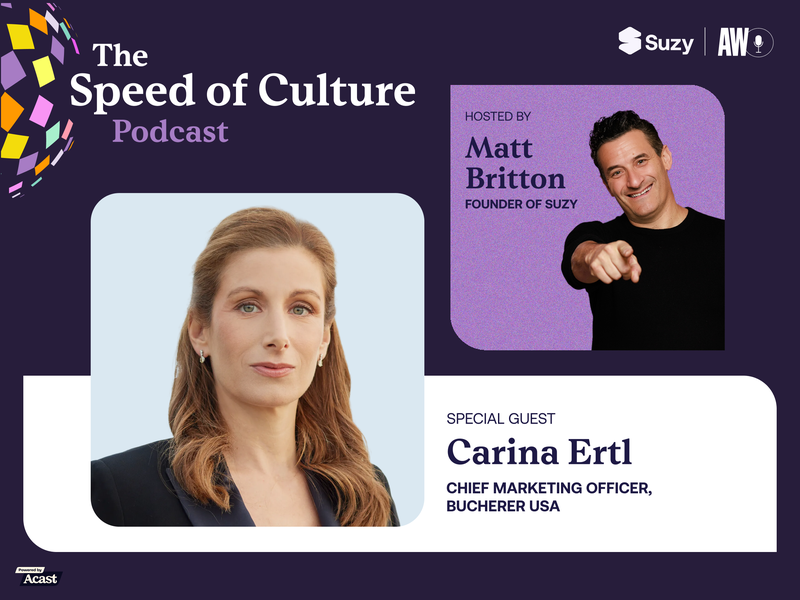
In the latest The Speed of Culture Podcast, Bucherer USA Chief Marketing Officer Carina Ertl talks to Matt Britton about the challenge of managing scarcity, how the reversal changes the job and why, in this case, marketing becomes less about reaching everyone and more about creating meaning for the people who enter the brand’s world.
The Product Is Only the Beginning
If we’re being honest, no one needs a mechanical watch. A phone tells the time perfectly well. Which is why the value has to come from somewhere else.
Carina describes luxury purchases as deeply connected to identity, milestones, memory, craftsmanship, and story. For Bucherer, that means marketing cannot stop at the object. Carina sees everything between product and sale as part of the product itself: the experience, community, belonging, trust, and relationship that eventually brings the client back.
Community Turns Ownership Into Belonging
That idea extends into collecting. This summer, Bucherer’s TimeMachine flagship in New York hosted Time Capsules, a contemporary art exhibition with Art Angels featuring artists Paul Rousso and Cedric Sequerra (SORA). The works explored why people collect, from sports memorabilia to magazines and pop culture artifacts, and what those objects reveal about memory and identity. Rather than simply displaying inventory, the flagship became a gathering place for people with a shared passion.
For marketers, the goal is not just foot traffic. It is creating a place where people with the same interests can connect. And, it’s a unique solution to a fascinating consumer challenge: they want individuality and belonging at the same time. The piece on their wrist can express something personal while also signaling membership in a community that understands why it matters.
Influence Is About Authority, Not Audience Size
The same principle shapes Bucherer’s creator strategy. Carina says some of the most successful partners are not influencers with millions of followers. They are curators with genuine passion for watches, and deeply engaged audiences.
The advantage here does not lie in their reach (as most marketers would assume), but rather in belief. The audience trusts that this person would care about the category even without a campaign attached. An approach like this transforms the partnership into shared culture rather than borrowed attention.
Pre-Owned Pieces Come With Stories Built In
Certified pre-owned is one of Bucherer’s largest and most actively marketed segments. Carina draws a clear line between a watch bought on just any resale platform and one that has been fully certified, and Bucherer’s own certified pre-owned program puts education and trust at the center of that difference.
Because many of these timepieces are no longer part of current assortments, each one arrives with a history of its own. Bucherer brings those stories to life through its El•e•vate Series, a cultural program staged in its Rolex Certified Pre-Owned spaces, where collectors, tastemakers and cultural leaders gather for conversations on authenticity and legacy.
For marketers, certified pre-owned is where scarcity, story and community meet. The scarcity is real: these pieces can’t simply be reordered. The story is already there. And the experiences built around them turn a one-time purchase into a reason to return. The advantage isn’t the watch alone, but the trust and belonging that come with it.
AI Raises the Value of What Cannot Be Copied
The conversation naturally pivots to the use of AI, and Carina is candid about using AI herself; she sees clear opportunities to improve processes. But she also sees an emerging luxury advantage in the analog experience. While an AI tool can help build an event concept, it can also give a similar concept to every competitor.
What remains harder to reproduce is taste:
- Understanding culture
- Spotting interesting subcultures
- Choosing the right collaborators
- Executing every detail with intention
That requires marketers to keep experiencing the world and leading with curiosity, not outsourcing the two to technology.
Luxury’s Advantage Is Becoming More Human
That brings up an important point: Luxury has an opportunity to move in the opposite direction. The more efficient marketing becomes, the easier it will be to replicate tactics. Content gets faster, campaign formulas spread, and digital experiences become more convenient.
So for luxury marketers, the goalposts have shifted:
- Scarcity creates desire
- Craft creates story
- Community creates belonging
- Human taste creates distinction
- Physical experience gives people something an algorithm cannot fully reproduce
That may be why the old-world qualities of luxury suddenly feel so relevant to the future. The product still matters, of course. But increasingly, the real advantage is everything surrounding it that cannot be copied with one click.