





How Do You Run Consumer Research Without an Insights Team?
In short: Rigorous consumer insights are a core part of how brands grow, and you can lead them without an insights team or research background. Start with the business decision, check what is already known, and picture the result that’ll secure buy-in. Then choose your audience and write the survey. Borrow the craft; keep owning the decision clarity.
Key takeaways
- Good research is framed around a decision with a deadline, not a topic.
- Before writing any questions, agree what result would make you act, for example “we launch the version that beats our best-seller on purchase intent.” Researchers call this an action standard.
- The groups you plan to compare set your sample size, because each one needs enough people to read on its own.
- Behavioral screeners (recent purchase, category usage, frequency) are more predictive of a qualified respondent than demographic stacks.
- ChatGPT and other general AI assistants can write a survey, but research best practices and rigor aren’t built in, so they can miss things that undermine your results.
- On Suzy, 95% of non-research professionals who use her to steer a survey build accept her suggested research objective or her improvements to it (Suzy platform data, Oct 13–20, 2026).
It often starts with a push to grow. You’re the first brand or strategy hire, brought in to take the business to the next stage. Or the company has just raised money and wants evidence behind its next big bets. Either way, consumer research is now yours to run, and it may be the first study your company has paid for. People will watch what it shows, and whether it shapes a decision.
You may also be doing it without a researcher to lean on, and you’re in good company. More than half of Suzy users (54%) aren’t research professionals (Oct 2026).
Here's the encouraging part. The things that make research work are things brand and marketing leaders already do every day: you make decisions, you know your customers, and you tell the story that gets a room behind a plan. This guide covers the craft around those strengths, in the order that makes it work.
What does consumer research cover?
Consumer research means asking the people who buy or use your products what they think and do, so you can make a business decision with evidence. It covers studies you run yourself, such as surveys, interviews and concept tests, and sources you already have, such as sales data, reviews and syndicated reports.
Most first studies settle one decision: whether a new product idea has legs, which claim to lead with, which pack design to choose, or what price holds. That decision is the thread through everything below.
How do you make the case for research to leadership?
Tie research to one upcoming decision, compare the cost of a wrong call with the cost of checking first, and start with one focused study. Many companies have grown on a founder's instinct, and that instinct is an asset. Research lets you test it before the big bets and take evidence into the meetings that matter.
Three moves make the case land:
- Tie it to one real decision. Not "we should do more research," but "before we launch the new range in spring, let's check which two versions customers prefer."
- Compare the costs. Set what a wrong call would cost in inventory, distribution or a relaunch against the cost of finding out first.
- Start with one study. A quick, focused win builds belief faster than a big program. Show the result, show the decision it shaped, then build from there.
One well-run study can change how leadership sees research. It carries weight across the company too: "We get really good engagement when we leverage Suzy studies and share that with our internal customers." (Brand manager, food company, mid-market)
Step 1. Start with the business objective and the decision
Start with the business objective: the result your company is working toward, such as a market share, revenue or distribution goal. It’s the north star for the whole study, because it tells you which decisions matter and what a good answer is worth.
Then name the decision that stands between you and that objective. A decision has options, a deadline and a result that would tip it. “What do customers think of our new product?” is a topic; “Which of three claims do we lead with at launch?” is a decision, and it’s far easier to research.
Before you draft a single question, capture four things:
- The business objective. The goal this research serves, and how you’ll measure it.
- The decision and its date. What you’ll decide on the way to that goal, and when you need the answer.
- The options. What you’re choosing between.
- The action standard. The result that would point you one way or the other. Researchers use this term for the bar a result has to clear, for example “we lead with the claim that beats the others on purchase intent.”
That gives you a chain to work from. The business objective is the goal, the decision is the choice that moves you toward it, and the research objective is the evidence you need to make that choice.
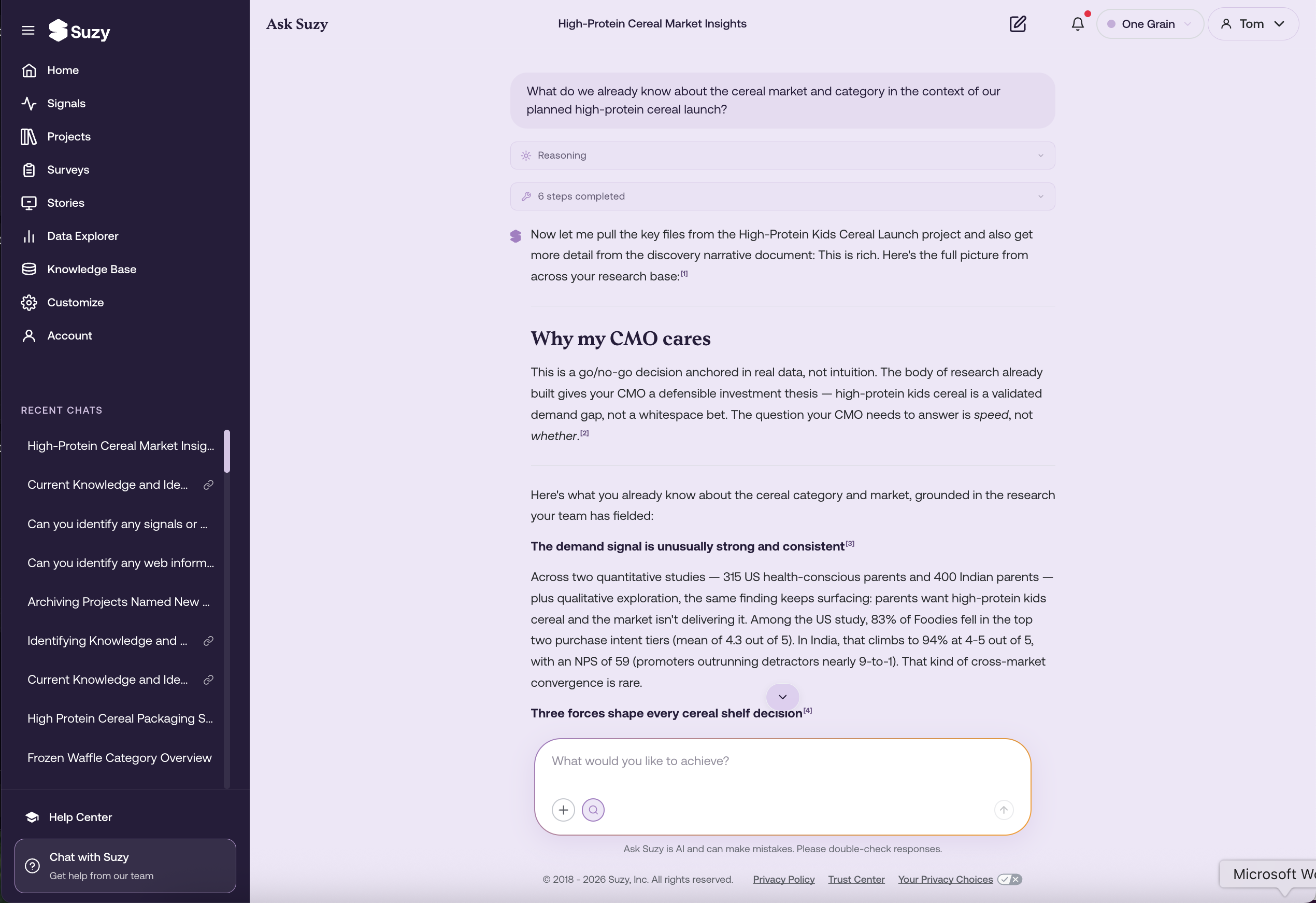
Illustrative example (One Grain is a fictional brand): One Grain is entering kids’ breakfast with a high-protein cereal made with natural ingredients. Its business objective is to launch the new cereal and reach 5% market share by the end of year one. One of the team’s knowledge gaps is which claim should lead the launch pack, so its research objective is to find which of three claims drives purchase intent among parents who buy kids’ cereal.
Turning a decision into a research objective is where most people want a second pair of eyes. Among people who use Suzy to help steer their survey build, 82% accept her suggested research objective or her improvements to it. Among those who aren’t research professionals, it’s 95% (Suzy platform data, Oct 13–20, 2026, 126 users).
However you get there, check that the final research objective ties back to the business objective, names the decision, and says what evidence would settle it.
Step 2. Gather what your company already knows
Before you spend anything, pull together what your company already knows: past studies, agency decks, sales data, customer feedback, reviews and support notes. It may answer part of the question, and it gives you a baseline, so you can say "up from last year" rather than presenting a number on its own.
Finding all of that takes longer than it should. In Atlassian's 2025 State of Teams survey of 12,000 knowledge workers and 200 executives, teams said they spend about 25% of their time searching for answers (Atlassian, 2025).
For more on why past research gets lost and the cost, see Research Amnesia.
Step 3. Picture the result you'll share
Imagine the finished slide before you write a question and decide on the sample size you need. Decide the metric, what you'll compare it with, and which groups you'll split it by. Those choices set your sample size, because every group you compare needs enough people to read on its own.
- Metrics. For example, purchase intent (how many say they'd definitely or probably buy), preference between options, or the reasons behind a choice.
- Benchmarks. What good looks like: your current product, a past winner or a category norm.
- Cuts. The groups you'll compare in the readout, such as current versus lapsed customers, shoppers at one retailer, or age bands.
A good general rule here is each group or concept you want to compare needs to be 100 in size. For a top-line read, with clear percentages and ability to spot clear differences, n=200-250 is adequate with no sub-groups being compared. If One Grain (in our fictional example) wants to compare across each of the three concepts, that's three groups and about 300 completes. For how confidence levels affect what you can claim, see Confidence levels in statistical significance.
Step 4. Choose who you need to hear from
Work back from your groups to your audience. A screener is the set of opening questions that decides who qualifies; quotas make sure each group fills up. Screen on recent behavior in your category, and keep a criterion only if it would change the answer.
- Screen on behavior. "Bought in the category in the last three months" tells you more than a stack of demographics.
- Add a check question. Include an option a real category buyer would recognize as wrong, so the people taking part are the people you want.
- Keep it as broad as the decision allows. Every extra criterion makes people harder to find and adds cost.
- Match quotas to your cuts. If a group from step 3 can't qualify through your screener, fix it now, not after fielding.
If your team has run studies before, start from the screeners that found the right people last time rather than building from scratch. In Suzy, the screener library holds templates you can reuse, so each new study starts from criteria you’ve already tested.
Step 5. Write questions that let people tell the truth
Neutral questions are what make leadership trust the answer. Four habits cover most of it: ask openly, hold back the brand until you need it, give people a way out, and ask one thing at a time.
- Ask openly. "How would you rate this product?" rather than "How much do you love our new product?"
- Hold back the brand name so people react to the product, not to you.
- Offer "none of these" or "other" so no one is forced into an answer.
- Ask one thing at a time: quality and value as two questions, not one.
Bias is one of the easiest things to introduce into a survey by accident. Our guide to reducing bias in your survey questions covers leading questions, order effects and the other common traps.
How do the five steps fit together?
Each step answers one question, and each answer shapes the next. The decision sets what you need to know, what you already know narrows it to a gap, and the result you picture decides who you ask and what you ask them.
Most of this is work you already do. You make decisions, you know your customers, and you tell the story that gets people behind a plan. Research puts evidence under each of those, step by step.
Here's how that runs for One Grain, a fictional brand that makes high-protein cereals for adults and is launching a kids' cereal made with natural ingredients.
Can you use an LLM to write a survey?
Yes, for a first draft. LLMs and other general AI assistants can draft a questionnaire in minutes, and with good prompts they get impressively close. Check the draft against the five steps, because a general assistant won't know your past research, and it tends to go along with a vague objective rather than question it.
Checking matters. In a 2025 study by KPMG and the University of Melbourne, 57% of US workers said they'd made mistakes in their work because of AI, and 58% had relied on AI output without evaluating its accuracy (KPMG, 2025).
If you enjoy building, it's a good way to learn. Just plan for what you'll own:
- The playbook: keeping best practices current and complete.
- The context: feeding in past studies, sales data and earlier decisions so the assistant knows your business.
- The challenge: good research benefits from someone asking "why do you want to know that?"
- The audience: a great draft still needs real, verified people to answer it.
More on this trade-off in You can build it yourself. You probably shouldn't.
How Suzy helps teams without an insights function
Suzy is a consumer research platform that carries the research expertise for you. She starts from your business objective and what your company already knows, guides the study build with best practices from more than 10 years of research, and ties the answers back to the decision you started with.
Here's how that maps to the five steps:
- What you already know. Suzy finds previous surveys, projects and files you've added that already answer part of your question. She helps you build briefs and learning plans that show what you know and where the gaps are.
- The decision. She recommends improvements to your research objective, and captures your business and research objectives so the answers stay grounded in them. 82% of people who use her to steer a build accept those objective suggestions.
- The build. Start from one sentence, a brief or a set of questions. Suzy guides you through questions, screeners, methodology and sample size, across quant and qual methods and US, global or your own audiences. She can review your build, and you can preview the survey before launch.
- The answer. Results are shown by objective. Chat with Suzy about what they mean and what to do next, and run data cuts in data explorer (cuts via chat are coming soon). You can share chats with colleagues who don't use Suzy.
She's honest about what's known and what isn't, so you know how far a result can carry. More than 400 clients, from $10M to $10bn+ in revenue, use Suzy today.
Already have a researcher?
If your company has an insights lead, they're probably fielding questions from every brand and marketing team. Suzy lets them open research up to those teams and stay in control: they add team members and set permissions [VERIFY: exact controls], and keep screeners consistent with reusable screener templates. Teams get answers sooner, and the researcher gets time back for the work that needs them most.
The bottom line
Research doesn't make the call for you. It makes the call clearer, easier to explain and easier to get behind. Every study adds to what your company knows, so the next decision starts further ahead than the last.
See what Suzy finds in research you've already run. Book a demo
FAQ
Do I need a research background to run consumer research? No. Brand and marketing leaders already bring the most important part: clarity about the decision. Templates, best practices and expert guidance can cover the technical craft of screeners, sampling and question wording.
What's the difference between a business objective and a research objective? The business objective is the result your company is working toward, such as 5% market share in year one. The research objective is the evidence you need for a decision on the way there, such as which claim drives purchase intent among likely buyers.
What is an action standard? An action standard is the result a study has to show for you to act, agreed before fielding. For example: "we launch the version that beats our best-seller on purchase intent." It stops results being read to fit a preference after the fact.
How many people do I need to survey? A good rule: n=100 is the minimum for any group you plan to analyze separately. So if you need 4 sub-groups, you're already at n=400 before you've thought about anything else.
What is a screener in a survey? A screener is the short set of opening questions that decides who qualifies to take a survey. Good screeners filter on recent behavior, such as buying in the category in the last three months, and include a check question to filter out people who don't fit.
What's the difference between concept testing and product testing? Concept testing measures reactions to an idea, such as a description, image or claim, before the product exists. Product testing puts the real product in people's hands, for example through an in-home usage test, to check how it performs and whether they'd buy it again.