





Who Is Your AI Really Working For? The Trust Problem Marketers Can’t Ignore
For the last two decades, digital marketing has become obsessed with one promise: better data would produce better performance. Joe Marchese thinks that skipped the more basic truth that without attention, the data does not matter.
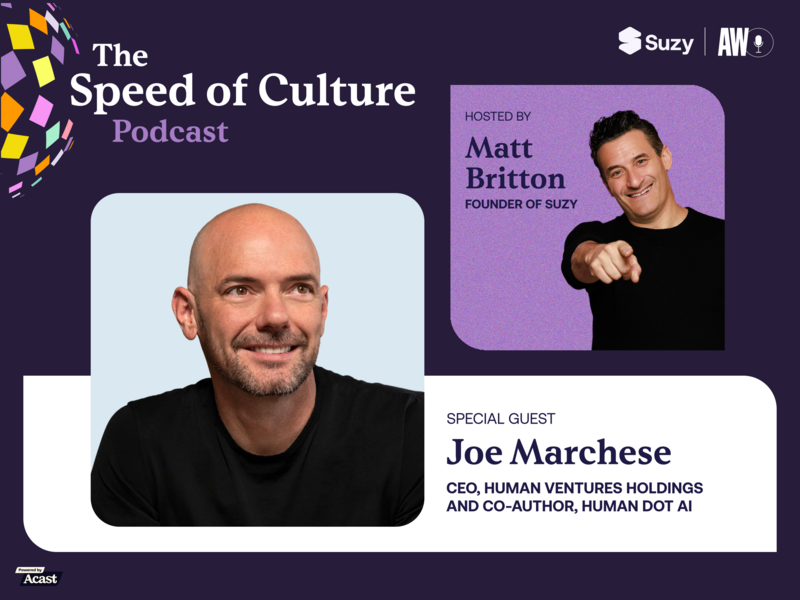
On The Speed of Culture podcast, the Human Ventures Holdings CEO and Human Dot AI co-author tells Matt Britton that the next phase of marketing raises an even bigger question: “When AI starts deciding what people see, buy, and trust, whose interests is it serving?”
Attention Was Always the Prerequisite
Joe built true[X] around the idea that an engaged viewer was worth more than another barely visible impression. The industry preferred volume because it fit neatly into spreadsheets, and attention simply did not. That made it easy to undervalue.
Joe’s simplest explanation still holds: he could know everything about someone, but without their attention, he cannot tell them anything. With attention and no data, he can still tell a story.
AI Makes the Incentive Problem More Personal
Algorithmic feeds have already shaped what deserves our attention. Now, AI agents take that a step further. They can converse with us, remember personal details, compare options, and increasingly act on our behalf.
Joe compares that relationship to a human agent. If a real estate or financial agent, for example, is meant to represent you, you want to know whether they are acting in your interest, right? AI deserves the same scrutiny. If an advertiser can influence the recommendation, can the consumer still trust the answer?
Optimization Pushes Advantage Somewhere Else
This creates a strategic shift for marketers. Joe argues that anything machines can understand will eventually be optimized. So, everything from media buying and targeting to other measurable activities becomes easier for everyone.
In a scenario like this, the advantage moves toward what remains difficult to automate: strategy, culture, experiential marketing, human connection. These are harder to scale and harder to quantify, which is exactly why they may become more valuable.
Brand Still Lives Between People
Performance marketing trained marketers to view impressions outside their narrow target as “wasted”. Joe calls that logic wrong. A brand needs to matter to the buyer’s friends, co-workers, partner and wider culture too. That is what he describes as “cultural currency”.
The point becomes even more important when AI starts mediating shopping decisions. If the machine can compare features and prices instantly, brand gives the human a reason to want one answer over another.
Human Experience Remains the Advantage
Joe’s investment thesis follows the same logic. He points toward events, hospitality, music, media tied to physical experiences and other spaces where people connect in real life. Those moments resist “optimization” because their value comes from being shared.
The New York City Marathon is powerful not because an algorithm can perfectly target everyone standing on First Avenue. Its power comes from the thousands of people who are experiencing the same cultural moment together.
The Future Advantage Is Hard to Measure
AI will make marketing faster, optimization cheaper, and will generate more content than consumers could ever possibly absorb. That does not make attention, culture, or brand obsolete; it makes them more scarce.
Joe’s argument is ultimately a warning against repeating the mistake digital advertising already made: assuming that whatever is easiest to measure must be what matters most. The next generation of competitive advantage may live in exactly the opposite place - the things machines cannot fully understand, the things dashboards cannot completely explain, and the human relationships that still determine what deserves our attention in the first place.