



How Data and Measurement Professionalized the Creator Economy
"Life is short. Do things you love." – Ryan Detert
Influencer marketing, going from an experimental hobby to a multi-billion-dollar enterprise business is one of the most significant stories in modern media. In the early days, social platforms were a playground for individual creators who focused on simple text and photos to build niche audiences. Today, those same platforms are the foundation for massive media buys that drive measurable business results for the world's largest brands.
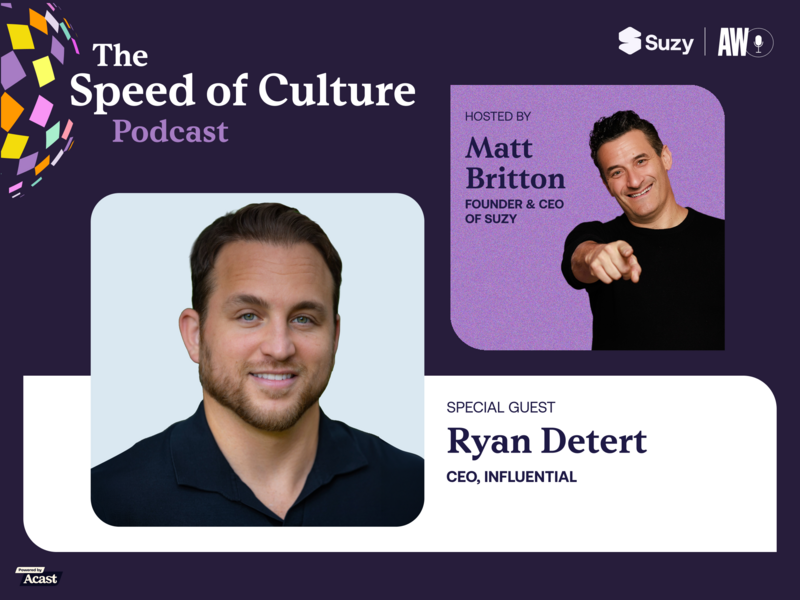
Ryan Detert, Founder and CEO at Influential, joined Matt Britton on The Speed of Culture podcast to provide a look at this journey. As an early architect of the creator economy, Ryan moved from managing parody accounts with 30 million followers to building a platform that partners with over 60% of the Fortune 500. His story is a testament to how a novelty becomes a necessary media channel through the application of data and a relentless focus on measurement.
The Evolution of the Niche Publisher
Ryan began his career as an influencer before the term "creator economy" was in common use. He managed accounts on Twitter and Instagram that functioned more like publishers than traditional personalities, focusing on topics like travel, automotive, and fashion. This publisher-style approach showed him that the value of social media was not just in the individual voice, but in the ability to align content with specific distribution channels.
He realized that for creators to truly monetize their work at an enterprise scale, they needed to provide the same professional standards found in traditional media. This meant ensuring brand safety, democratization of access to talent, and, most importantly, reliable measurement. It was the catalyst for building Influential, going from being an individual contributor to creating a marketplace that could bridge the gap between agencies and creators.
From PR Budgets to Media Dollars
One of the most significant changes Ryan describes is the change in how brands allocate their spending. In the early years, influencer campaigns were often limited to small PR or sponsorship buckets, which restricted them to $25,000 experimental projects. The industry reached a turning point around 2016 when the marriage of native creator content with paid media amplification allowed these campaigns to function as media buys.
This allowed budgets to grow from small tests to eight and even nine-figure annual spends. By treating influencer content as "working media" that could drive specific KPIs, brands began to see it as a viable alternative to traditional advertising channels. This maturity has paved the way to "always on" scenarios where creators are a permanent part of a brand's media strategy.
The End of the Follower Obsession
The conversation also addresses the changing definition of influence. Ryan notes that the antiquated model of selling "glitz and glamour" through massive subscriber counts did not necessarily lead to business outcomes. The industry has moved toward the micro-creator, whose audience often has a much higher affinity for specific topics like DIY or sports.
Targeting a specific demographic, such as females aged 25 to 34 with an interest in a particular niche, provides a much higher ROI than a celebrity with hundreds of millions of generic followers. The quality over quantity assessment is why influencer marketing has become a sophisticated media buy. It is about finding the right voice for the right audience at the right moment.
The Reality of AI and Brand Safety
While AI is a central topic in 2026, Ryan offers a candid perspective on its role in the industry. Influential has used AI for nearly a decade for sourcing creators and validating brand safety. However, when it comes to generative AI content, he observes a significant amount of hesitation among major brands. The perception of "AI slop" or clickbait has created a negative sentiment that many Fortune 1000 companies are not yet willing to risk.
There are also growing concerns regarding the rights of creators. Issues surrounding name, image, and likeness are central to the conversation, as the community looks for ways to prevent their identities from being used without consent or compensation. Ryan suggests that while D2C brands may experiment with AI humans, larger enterprises are moving in the opposite direction, often requiring contracts that prohibit the use of AI in campaign creative.
Integration with Data Powerhouses
The acquisition of Influential by Publicis Groupe represents the next phase of the creator economy. Added capabilities like these move the needle from simple audience demographics to actual purchase history and consumer behavior.
By proving that a campaign can drive offline sales, foot traffic, or TV tune-in, the industry removes the skepticism that once surrounded social media. Data is the engine that turns influence into a media channel, providing the intelligence required to make better decisions for brands and drive outsized gains for clients.
Building on a Foundation of Trust
Despite the focus on data and technology, Ryan emphasizes that the human element remains at the core of his success. He built Influential with a team of friends and family, including his brother and lifelong friends. The company has stayed focused on its mission to innovate towards measurement based on this foundation of trust.
His advice for the next generation of founders is to work with people they trust and to always aim for something bigger than what they could achieve alone. The knowledge that business is all-encompassing makes the choice of partners one of the most critical decisions an entrepreneur can make.