

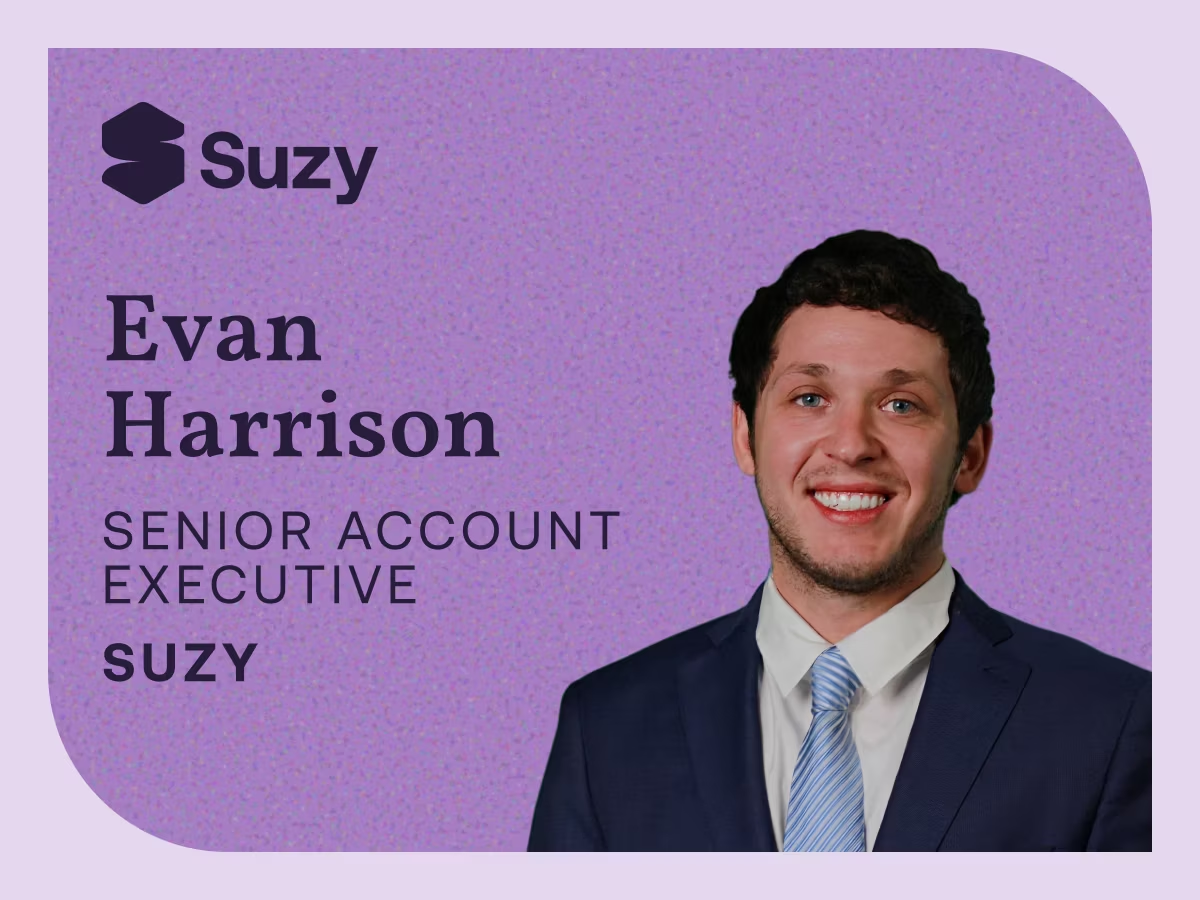

By Evan Harrison, Senior Account Executive at Suzy
In my role selling into enterprise brands, I’ve started to notice a shift in how buyers evaluate software. Historically, the conversation centered around features, dashboards, and how a tool fit into an existing workflow. But increasingly, those conversations are changing.
Buyers aren’t asking "what can this platform do?" They’re asking "what will this actually do for me?" There’s a growing expectation that software shouldn’t just enable work, but actually complete it.
I’ve seen firsthand how quickly AI is changing expectations. Systems that used to require extensive training, manual navigation, and heavy lifting are being replaced by platforms that can interpret a request and take action. Most SaaS companies aren’t being disrupted by AI. They’re being exposed by it. This is a fundamental reset.
The Interface is a Tax
For the last fifteen years, we sold the "Command Center." We told executive leadership that if they just gave their teams another login, another dashboard, and another three days of onboarding, they would finally have the solution to their business problems.
In hindsight, we were perhaps too optimistic. We left these leaders in a state of operational paralysis. They weren't solving problems; they were just managing more tabs.
Every management interface is a tax on a person’s time. It is an instruction manual disguised as a solution. You don't want to navigate a portal. You want the three bullet points that tell you why your market share in the Midwest is slipping. The UI was always a middleman. Now, that middleman is getting fired.
The UI was never the product. It was the workaround.
The SaaSpocalypse: A Market Wake-Up Call
The market isn’t just speculating. It is reacting. Recently, the SaaS market saw a sharp correction – what some have called the “SaaSpocalypse” – wiping out massive amounts of value in a short period of time. Why? Because the market realized that a significant portion of the SaaS "moat" was just a pretty layer of glass sitting on top of a database.
Investors and buyers alike are waking up to the reality of Business Model Debt. We’ve reached peak tool. The average enterprise is drowning in hundreds of apps, creating a "friction tax" where humans spend more time managing software than doing the work the software was bought to do.
If your value proposition is simply being a bit more intuitive than the legacy incumbent, you are already a commodity. In 2026, being "user-friendly" is the floor. Autonomy of execution is the new ceiling.
From Instruction to Intent: A New Interaction Model
We are moving from Instruction-Based Computing to Intent-Based Computing.
- Instruction-Based (The Legacy): You click "Filter," select "Date Range," choose "Region," export to CSV, and build a pivot table. You are the expert. The software is the shovel.
- Intent-Based (The Future): You type, "Compare our Q4 brand sentiment against the top three competitors and highlight where we are losing Gen Z." Instead of pulling reports before a quarterly business review, a team can now ask for a full breakdown of performance, key risks, and recommended actions – and get it instantly.
This isn’t just a new capability. It’s a fundamental shift in how we interact with data. When the interface is natural language, the learning curve disappears. Change Management, the perennial boogeyman of enterprise sales, is becoming a relic of the past. If you can send a Slack message, you can run a global research study.
The Rise of the Applied AI Brand
The brands that are going to win this era are Applied AI companies. These are the organizations that aren't just using AI, but are deploying it to solve currently broken workflows.
This is a reset.
Historically, industry knowledge was gated behind decades of experience or expensive gatekeepers. Now, that preconceived knowledge about an industry is available to everyone via the model. This levels the playing field. The winner isn't the one who has been in the room the longest, but the one who can apply this intelligence to make better decisions, faster.
A CPG brand testing creative used to wait two to three weeks for results. Now they can test, iterate, and re-launch within 48 hours. I recently spoke with a research lead who was spending 20 hours a week just cleaning data and formatting slides. When she saw an agentic workflow ingest raw consumer video, transcribe it, and generate a summary in four minutes, her first question wasn't about the buttons. It was: "What do I do with those 20 hours now?"
Turning Signals into Stories
Even if you have the fastest data in the world, it dies if it stays in a spreadsheet. One of the biggest frustrations I hear from marketing managers is the "Manual Bottleneck." They spend entire days manually synthesizing primary research into presentation decks for leadership.
This is where platforms like Suzy are evolving.
In the old world of software, you would spend a week formatting a 70-slide "master deck" that no one would read. In the new world, research doesn't just inform – it becomes instantly actionable. Suzy tools like Stories automate the synthesis process, turning complex data into polished, presentation-ready narratives. It is about impact, not just information. It is moving from "we have data" to "we have a plan."
Solving for Business Problems, Not Logins
As an AE, I’ve seen the "per-seat" model start to feel increasingly disconnected from reality. If an AI agent can do the work of ten people, charging for ten logins breaks.
CFOs don’t care how many seats you sold. They care how much work got done.
At Suzy, we are leaning into usage-based pricing that aligns directly with solving business problems. We want to move away from the "access" model and toward a structure that helps improve core business metrics. This shift allows you to finally put the old ROI calculator down.
When software is priced based on the value it creates and the problems it solves, you don't need a complex spreadsheet to justify the spend. The results speak for themselves. You aren't paying for a "license" to use a tool; you are paying for the intelligence required to win your category.
The Human Advantage: Relationships as the New Moat
If execution becomes a commodity—if anyone can generate a chart with a prompt—what is left?
Strategy, Trust, and Ground Truth.
AI can generate answers. It can’t own consequences. In a world of automated outcomes, the value of the human relationship becomes more important, not less. As an AE, my job is no longer to sell you a subscription to a platform. It is to be a strategic partner who ensures the "Intent" you are giving the machine is the right one for your business.
The only real competitive advantage left for brands is proprietary data: the "Ground Truth" that AI models can’t guess. If you don't own the direct line to your consumer, your AI is just hallucinating based on the same public data as everyone else.
The Suzy Solution: Insights at the Speed of Intent
This shift is exactly why we’ve built Suzy the way we have. We aren't interested in giving you more portals to manage.
With Speaks, our AI-moderated research tools, we are removing the friction tax of the old UI. We’ve replaced the manual heavy lifting of traditional research with a system that understands your intent. You ask the question, Suzy finds the audience, conducts the interview, and then Stories synthesizes the result into a narrative that moves your board to action.
We’ve moved from a research project that takes weeks to a strategic conversation that takes minutes. We aren't just a tool you use. We are the system that acts on your behalf to help you make better decisions.
Conclusion: The Fundamental Reset
The buyers I talk to every day aren't looking for more functionality. They are looking for time. They are looking for the ability to be right, faster.
The era of "Software as a Service" is being replaced by "Software as a Result." The UI is receding, the dashboard is dying, and the "seat" is a legacy metric.
When that research lead asked me, "What do I do with those extra 20 hours?" the answer was simple. You lead. You stop managing software and start managing the future of your brand.
The question isn’t “do you have AI?” It’s “what is your AI actually doing?”
In 2026, you either own the outcome – or you become overhead. This is your fresh start. Don't waste it.
Why is "Applied AI" disrupting the traditional SaaS business model?
Applied AI shifts the focus from "tools" to "solutions." By automating broken workflows and providing instant access to industry knowledge, Applied AI allows brands to bypass the manual labor of data synthesis. This disruption is leading to a move away from seat-based pricing toward usage-based models that solve for business problems rather than just providing access to a UI.
Strategic Takeaways for Executives
- Kill the Manual Bottleneck: Replace tools that require manual data synthesis with agentic systems that produce polished, actionable narratives like Suzy Stories.
- Shift Pricing Models: Prepare for a transition from per-seat licensing to usage-based pricing that reflects business metric improvements.
- Leverage the Fresh Start: Use the democratization of industry knowledge to challenge legacy incumbents and rethink your category strategy.
- Focus on Business Metrics: Evaluate new software based on how it improves core KPIs rather than how many users it can support.
Book a demo or explore Suzy’s platform today.