



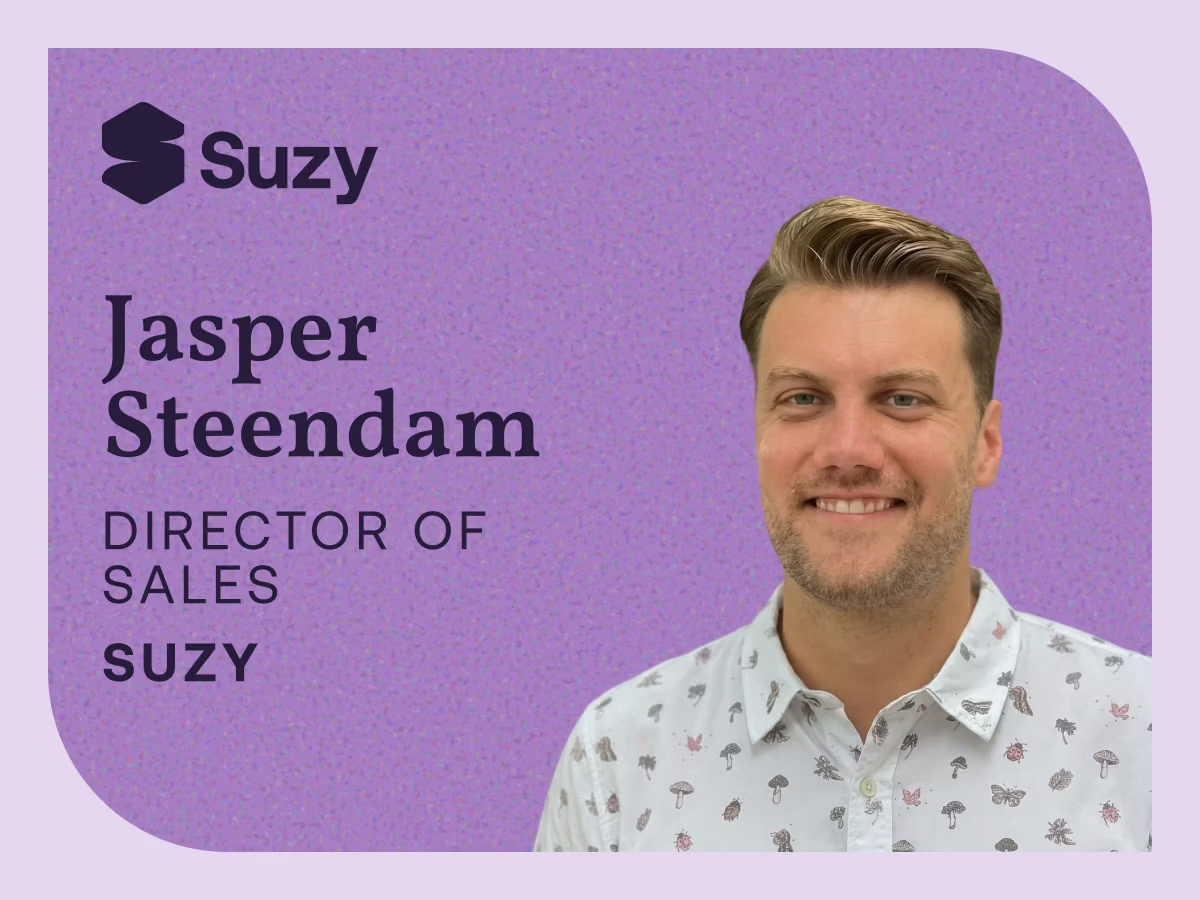

By Jasper Steendam, Director of Sales at Suzy
I’ve never been there myself, but it’s at the top of my bucket list. I can already see the walk down Magnolia Lane – not because I’ve lived it, but because I’ve been fascinated by way they protect the "purity" of the game. For most of us, tomorrow is the day our television remotes get a workout. For the lucky few with a badge, it’s the day the modern world stops.
Because at the Masters, the policy is simple: Leave your phone in the car or leave the grounds. There are no "warnings." If you’re caught checking a Slack notification or trying to snap a photo of Amen Corner, your badge is gone. It’s an expensive mistake, a total buzzkill, and a heart-wrenching way to lose a once-in-a-lifetime opportunity just for a blurry photo that 5,000 other people have already posted.
But here’s the thing: Augusta National isn't anti-technology. Far from it. They have perhaps the most sophisticated sports app on the planet—a masterclass in UX that lets anyone stream every shot, from every hole, for free.
The phone ban isn't about being stuck in the past. It’s a strategic decision to create a Digital Sanctuary. By forcing the phone out of the hand, they ensure that the "Patron" experience is high-signal, unmediated, and entirely human.
In my world as a Director of Sales, I see brands struggling with the exact opposite. They are drowning in "Static" – the billions of digital breadcrumbs left by people who are physically present but mentally miles away. To win in 2026, you have to find the "Signal." And to do that, you have to look at the man who didn’t record the shot.
What’s happening: The 2026 analog renaissance
We are currently seeing a massive cultural correction. After years of "omnichannel" everything, the 2026 consumer is craving boundaries. Research shows that "Digital Detox" is no longer a niche wellness trend; it’s a mainstream survival tactic. In fact, latest reports indicate that searches for "analog hobbies" and "phone-free travel" have spiked by over 130% this year alone.
Consumers are hitting a wall of digital fatigue. Gartner’s 2026 marketing survey found that 68% of consumers now frequently question whether the content they see online is even real, and a similar number feel a deep nostalgia for pre-digital times. We are living in an era of "Reality Skepticism." When everything is a filter, a deep-fake, or an algorithmic suggestion, the only thing people trust is what they can see with their own eyes.
Augusta National’s "no-phone" policy is a master class in responding to this shift. While other sporting events are frantic to install 5G and QR codes for "engagement," the Masters understands that presence is the new premium. By creating an environment where you cannot be reached, they have made the physical experience of the tournament the ultimate luxury.
Consumer POV: The runner’s high and the desire for presence
What’s going on in people’s minds? They are tired of being "users" trapped in a scroll; they want to be "patrons" who are actually heard.
I’ve been running for years without my phone. No podcasts, no texts, no curated playlist, no distraction. Just the rhythm of my breath and the sound of my shoes hitting the pavement. It’s uncomfortable at first – the "digital itch" is real. But after ten minutes, something shifts. I start noticing things I’ve passed a thousand times: the specific way the light hits a certain building, the smell of the air before a storm. Without the phone, I’m not a "user" on a trail; I’m a human being fully present in my environment.
Your consumers are exactly the same. When the screen goes away, their expectations for real, consistent, and "human" value skyrocket. They aren't looking for a viral moment; they're looking for the "Michelob Ultra Guy" experience. Recall the viral photo of Mark Radetic from the 2022 PGA Championship. Tiger Woods is mid-swing, and the gallery behind him is a sea of glowing rectangles. Hundreds of fans are viewing a legendary moment through a lens, more worried about "capturing" the event than experiencing it. Except for Mark. He stood there with a beer in one hand, his eyes on the ball, and his phone nowhere to be seen. He was the only person in that frame who was actually there.
In 2026, your customers are looking for their "Michelob Moment." They are looking for brands that respect their attention rather than mining it.
Why research matters: Finding the Signal in the static
This shift creates a massive crisis for traditional market research. Most of your "consumer data" is coming from people who are living in 2D. They are distracted, toggling between tabs, and giving you 10% of their brain. If you base your strategy on that data, you’re building a house on "Static."
To find the "Signal," brands must move toward conversational resonance. This is where the outcomes of iterative, human-centric research change the game. When you move past the "Static" of click-rates and into real-time, one-on-one human dialogue, the results are transformative.
Think about the $1.50 pimento cheese sandwich at Augusta. In a world of rampant inflation, that price point is a "Sacred Cow." It tells the patron: We aren't here to squeeze you. We’re here to host you. At Suzy, we spend a lot of time helping our clients identify those emotional outcomes. We don't just look at what people will pay; we look at the trust signal that a price point or a product feature creates. When you find the one thing your customers refuse to let you change, you’ve found your "Green Jacket."
You can’t find that kind of insight through a passive survey. You find it through Speaks, our AI-moderated conversational surveys – by stepping into that "phone-free" zone with your customers. When you have a real conversation, you aren't guessing why a consumer chose your competitor; you’re hearing the nuance in their voice when they describe their daily frustrations. You’re seeing the "HD version" of their life.
The sales leader’s imperative: Pivot or perish
As a Director of Sales, my advice to you is this: Don't just chase the people holding the phones. The "clicks" are a lagging indicator of a distracted mind. If you want to build a brand that lasts as long as Augusta National, you have to build for the person who is present.
The brands winning in 2026 are the ones moving away from massive, anonymous data sets and moving toward High-Signal Environments. They are looking for research that mimics the Augusta experience – one-on-one, deep-focus, and human.
The outcome of this approach isn't just a better slide deck for your QBR. The outcome is certainty. In a world of noise, the brand with the clearest signal wins every time. You gain the ability to predict how your customers will react to a price change or a new product launch because you've actually listened to them, not just tracked them.
Conclusion: Tomorrow, the Signal returns
As the first round begins tomorrow morning, millions will engage with the Masters through that beautiful, free app. They’ll see every shot and track every stat.
But the real magic is happening for the people who can’t use the app. The people standing behind the ropes at the 12th hole, forced to be silent, forced to be still, and forced to be present.
The Masters is the pinnacle of sports not because it has the best digital tools – though it does – but because it protects the experience of being a human being. The brands that win in 2026 won't be the ones with the loudest digital presence. They’ll be the ones that provide a sanctuary for their customers. They’ll be the ones that value the signal over the static.
Because when the phones finally go down – and in 2026, they are going down more and more – the only thing left will be the connection you were brave enough to build.
Want to learn more about finding your brand's "High-Signal" truth? Let’s talk.
How can brands leverage the "Analog Renaissance" to improve consumer insights in 2026?
The "Masters Model" proves that high-value engagement is built on "presence," not just "reach." As consumers increasingly seek digital-free sanctuaries due to 2026 digital fatigue (with 70% of people wishing they spent less time on devices), brands must shift their research and marketing focus away from "Static" (distracted, passive data) toward "Signal" (deep, unmediated human conversation). Tomorrow’s leaders will be defined by their ability to foster uninterrupted connections and maintain radical consistency in their core value propositions.
- Embrace the Phone-Free Mindset: Look for research methodologies that demand undivided attention rather than multi-tasked "click" data.
- Identify Emotional Moats: Use iterative feedback to discover the "Sacred Cow" features that drive lifelong loyalty and price integrity.
- Value Depth Over Volume: In 2026, one "High-Signal" human conversation is more predictive of success than 1,000 "Low-Signal" data poi