





The hidden cost of disconnected intelligence
The modern marketer doesn't have a data problem. They have a decision problem.
There's a particular kind of frustration that every marketing leader knows but rarely talks about openly. It's not the frustration of having too little information. It's the frustration of having too much of it, scattered across too many places, owned by too many teams, and formatted in too many ways to ever come together when it actually matters.
Dashboards from three different analytics platforms. Vendor reports that arrive quarterly and sit unread for weeks. Consumer studies buried in shared drives. Competitive intel trapped in someone's inbox. Cultural trends surfacing on social that no one has time to pressure-test. Slack threads where someone mentioned something important two weeks ago, but nobody can find it now.
It's all there. And none of it connects when the decision hits.
This is the hidden cost of disconnected intelligence, and for enterprise marketing organizations, the price tag is far larger than most leaders realize.
The $40 Million Problem No One's Measuring
For a $1B-revenue enterprise, conservative estimates put the annual cost of fragmented intelligence at $40 million or more. That number sounds dramatic until you start breaking it down.
Start with redundant research. How many times has your organization commissioned a study only to discover weeks (or months!) later that a similar study already existed somewhere in the organization? How many agencies have delivered overlapping competitive analyses to different brand teams who never compared notes? Research redundancy alone can account for millions in wasted spend annually at large organizations, and it's almost never tracked as a line item.
Then there's the cost of slow decisions. In a market where consumer trends emerge and fade in weeks, a traditional research cycle that takes six to eight weeks isn't just inconvenient. It's a competitive liability. Every week a team spends waiting for data to validate a strategic direction is a week a faster competitor spends executing. Multiply that across dozens of decisions per quarter, and the opportunity cost becomes staggering.
But the most expensive line item is the one that never shows up on a balance sheet: misalignment. When different teams are working from different data sets, interpreting different signals, and building different narratives, the organization doesn't just slow down. It fractures. The brand team sees one story. The media team sees another. Finance sees a third. And the CMO walks into a board meeting with a point of view that half the organization can't fully support.
The result? Hedged bets. Delayed launches. Campaigns that get watered down by committee because no one had a single source of truth compelling enough to align the room.
Why this problem is getting worse, not better
You'd think that with all the investment enterprises have made in data infrastructure over the past decade, this would be getting better. It's not.
The average enterprise marketing organization now operates across dozens of tools: social listening platforms, brand tracking dashboards, survey tools, CRM systems, media mix models, competitive intelligence feeds, and more. Each tool does its job reasonably well in isolation. But no one's job is to connect them.
The insights team runs studies. The analytics team builds dashboards. The strategy team writes decks. The agency delivers its own perspective. And the marketing leader is left to be the human connective tissue: the person who's supposed to synthesize all of it into a coherent point of view and a defensible plan of action.
That's an impossible job. Not because marketing leaders aren't smart enough, but because the volume and velocity of information has outpaced any individual's ability to manually reconcile it. And the traditional solution, hiring more analysts, buying more tools, commissioning more research, only adds more inputs to a system that was already overwhelmed.
The problem isn't the quantity of intelligence. It's the absence of a connective layer between what you know, what you still need to learn, and what you need to decide.
The three gaps that define the crisis
When you look closely at how disconnected intelligence actually manifests inside an organization, it tends to show up in three distinct gaps.
The Signal Gap
This is the space between what's happening in the market and when your team becomes aware of it. Cultural shifts, competitive moves, emerging consumer behaviors - these signals exist in the world long before they land on anyone's desk. Without a systematic way to surface what's relevant, marketing teams are perpetually reactive, learning about the trends that matter to their brand only after those trends have already peaked or been claimed by a competitor.
The Synthesis Gap
Even when the right information exists inside the organization, it rarely lives in one place. Market data sits in one platform. Consumer research lives in another. Strategy documents are in a shared drive. Competitive intel is in someone's email. The synthesis gap is the space between having the pieces and seeing the picture, and it's where most marketing teams lose the most time. Leaders report spending more hours assembling information than actually thinking strategically about what it means.
The Activation Gap
This is perhaps the most painful one. You've done the work. You've gathered the evidence. You know what the right move is. But now you have to convince six different stakeholders, each of whom needs the information presented differently. Your CMO needs a narrative. Your brand manager needs a tactical brief. Your finance team needs a model that ties back to revenue. One set of evidence, rebuilt and reformatted over and over, and by the time alignment is reached, the window may have already closed.
These three gaps - signal, synthesis, and activation - compound each other. Miss a signal, and your synthesis starts from the wrong place. Struggle with synthesis, and your activation stalls. Stall on activation, and the decision either gets made too late or doesn't get made at all.
The personal cost behind the organizational one
There's a human dimension to this problem that deserves attention, too. Marketing leaders at enterprise organizations carry an unusual kind of professional risk. They're making million-dollar bets on campaigns, on product positioning, on media spend, on innovation pipelines, and the consequences of getting it wrong are both financial and reputational.
The fear isn't abstract. It's the fear of walking into a CMO review without a data-backed point of view and getting caught flat-footed. It's the fear of investing $10 million in a media strategy and not being able to prove it worked when the CFO comes asking. It's the fear of knowing, intuitively, that a particular strategic direction is right but not being able to assemble the evidence fast enough to survive the next budget cycle.
Disconnected intelligence doesn't just cost the organization money. It costs individual leaders confidence to make bold calls, to move quickly, and to stand behind their decisions in every room that matters.
What needs to change
The answer isn't more data. It isn't more tools. It isn't more headcount on the insights team.
What enterprise marketing organizations need is a fundamentally different approach to how intelligence flows through the organization from the moment a signal appears in the market to the moment a team acts on it. That means closing all three gaps simultaneously: surfacing what matters before you have to ask, connecting every source of knowledge around the decisions you're actually trying to make, and shaping the evidence to drive alignment with every stakeholder who needs to say yes.
This isn't a technology problem in the traditional sense. It's a structural one. And solving it requires rethinking the relationship between data, insight, and action from the ground up.
Something new is coming
We've spent the last several years listening to marketing leaders describe this exact problem: the disconnection, the redundancy, the misalignment, the cost. And we've been building something to solve it.
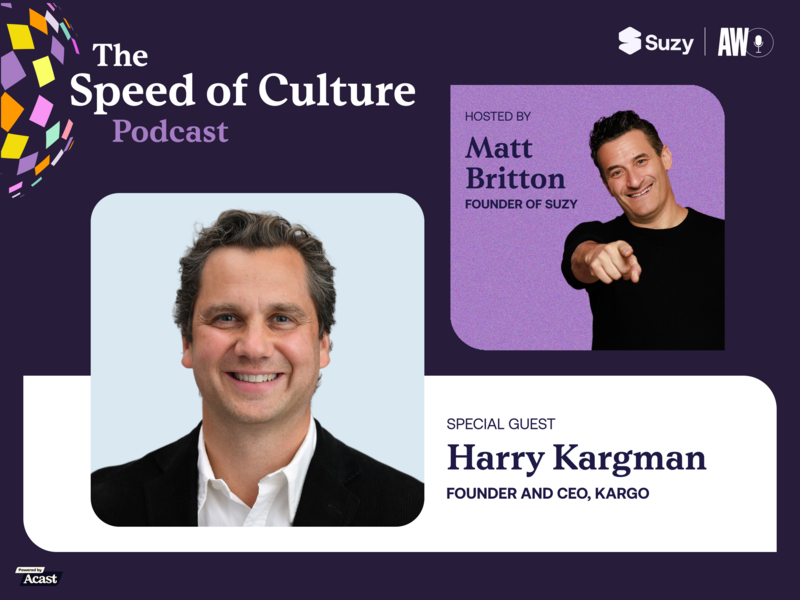
On April 8th, we're hosting an exclusive webinar where Suzy Founder & CEO Matt Britton will unveil the most significant evolution in our platform's history: a completely new approach to how marketing organizations turn fragmented data, market signals, and consumer research into decisions their whole team can act on.
This isn't a feature update. It's a new category of capability, and it's built for how modern marketers actually work.
In this session, you'll learn:
- Why disconnected intelligence is the most expensive problem in enterprise marketing and how to quantify what it's costing your organization right now
- The new framework behind this platform evolution and how it transforms every stage from signal detection to organization-wide action
- A live, first-ever look inside the platform, including capabilities that have never been shown publicly
- Early results from enterprise teams already using this approach to cut decision cycles, recover wasted spend, and move faster than their competitors
If you lead marketing, brand strategy, or insights at an enterprise or mid-market organization, this is the most important hour you'll spend this quarter. This is a first look at something we've never shown before, and you'll want to be in the room when we do.
Register for the April 8th Webinar