




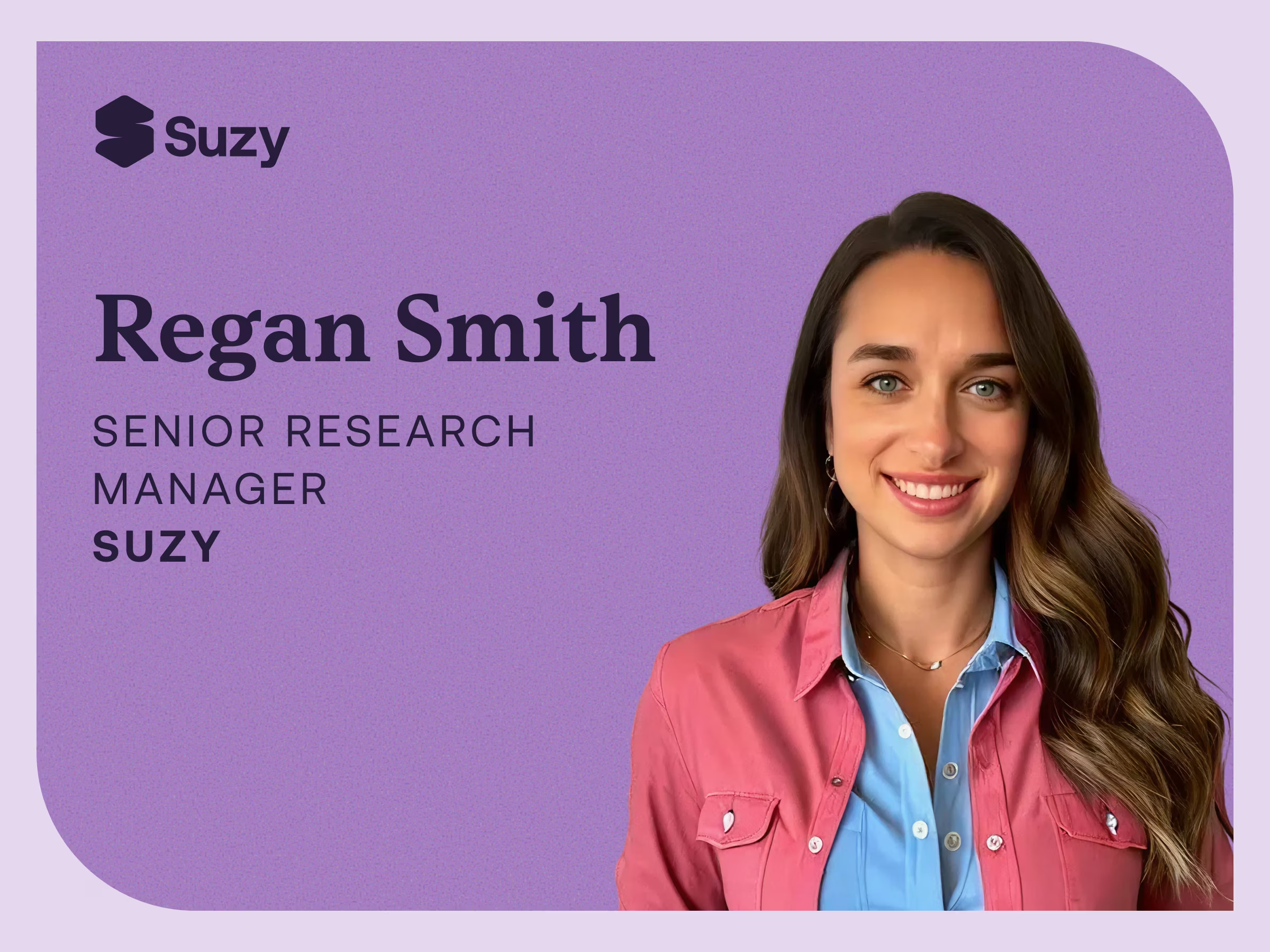

By Regan Smith, Senior Research Manager at Suzy
Empathy in research is not about being emotional. It is a practical way to ask better questions, listen without bias, and uncover the why behind the data. Early in my career, I tried to mute empathy to look rigorous. Over time, I noticed that my best insights appeared when I understood the person behind the response. Hearing what people meant, not just what they said, helped me write sharper prompts, spot nuance in the data, and connect dots others missed. What I was told was a weakness became a superpower.
This article shows how empathy strengthens rigor rather than replaces it. We will examine the skills that make empathy operational, show how it reduces bias and improves data quality, and share ways to weave it across qualitative and quantitative work. Throughout, we will highlight how Speaks, Suzy’s AI moderated interviews, bring human understanding and statistical confidence together in real time.
Why empathy belongs in a rigorous research toolkit
Empathy improves data quality through better listening
High quality research starts with high quality listening. In qualitative work, the researcher is the instrument. Strong listening behaviors are linked to richer, more relevant responses and to detail that static question lists often miss. Reviews of qualitative practice identify good listening as a marker of study quality because it surfaces context, contradiction, and meaning that would otherwise remain latent.
Active and empathic listening techniques also lengthen responses and increase their usefulness, even for experienced interviewers who think they already listen well. That improvement flows directly into better datasets and cleaner analysis.
Beyond interviews, listening has measurable effects on cooperation and performance. A meta analysis covering hundreds of thousands of observations finds that perceived listening improves outcomes through affect, cognition, and relationship quality. When people feel heard, they disclose more fully and collaborate more effectively, which benefits any interaction that relies on human truth telling.
Empathy enhances respondent experience, which strengthens results
As conversational and AI assisted research scales, participant experience becomes a quality lever. People share more honestly when they feel respected, safe, and understood. Suzy’s AI-powered conversational surveys, Speaks, emphasizes participant first design: simple, neutral prompts and voice responses let people answer in their own words and on their own time, which helps respondents feel heard and share more context. Empathic listening also satisfies psychological needs for autonomy and relatedness, which supports self disclosure and clarity in the moment. When people feel listened to, they tend to go deeper and reveal the context behind their choices.
What empathy is, and what it is not
Empathy is a disciplined method, not a mood
Empathy in research is the habit of perspective taking. It is the practice of asking what a person might mean, feel, or assume, then using that understanding to guide the next prompt, probe, or analysis step. Design scholarship clarifies that empathy blends cognitive understanding and affective attunement that can be trained and evaluated. That makes it a legitimate method rather than a personality trait.
Empathy is not agreement. It is not indulgence. It is listening for meaning without projecting our own frames, then translating that understanding into neutral probes and clearer logic.
Empathy reduces bias rather than creates it
The critique that empathy introduces softness confuses feeling with method. Empathy helps researchers notice leading language, avoid funneling respondents into assumptions, and triangulate competing signals. Triangulation is a backbone of credibility. Using multiple perspectives, data sources, and methods reduces the risk that any single bias drives a conclusion. In market research, that means pairing qualitative depth with quantitative sizing, cross checking segments over time, and layering behavioral signals with stated attitudes.
How to operationalize empathy across the research lifecycle
Plan with empathy: Write AI interview flows that listen
Empathy starts before fielding. Effective AI moderated interview flows anticipate the human reality of answering questions. They keep language neutral, create space for stories, and include probes that clarify context without steering.
- Ask open, non-stacked questions. Start broad, then narrow. Avoid assumptions that corner respondents.
- Design for cognitive comfort. Use simple language, short blocks, and clear time expectations.
- Integrate laddering with care. Use prompts like “Tell me more about that,” “What led you there,” and “What might be different if” to unpack values without imposing them.
Speaks uses a consistent prompt set to capture authentic voice responses at scale. Teams receive transcripts and clips that surface the why behind behavior, which can inform follow up waves or complementary quant.
Recruit and set context with empathy
Empathy shows up in invitations and screeners. It is transparent about purpose and respectful of time, which reduces drop off and satisficing. Asynchronous, AI moderated interviews remove scheduling friction and let respondents answer in their own space. That widens reach and often yields more candid disclosure. The principle is simple. When participation feels fair and safe, data quality rises.
Moderate with empathy: skills that raise the signal to noise ratio
Empathic moderation is not about being nice. It is the disciplined use of listening to reduce fear of judgment and surface meaning. These micro skills matter whether the moderator is a person or an AI agent tuned for empathic behaviors.
Five core skills
- Presence. Focus attention on the speaker. Feeling heard depends on attention and action, and people disclose more when they believe the listener is engaged and will use what they share.
- Reflective paraphrase. Repeat the gist plus the emotion. This lowers defensiveness and often surfaces contradictions worth probing.
- Open and neutral follow ups. Ask “What makes you say that,” “Walk me through the last time,” and “How would this compare to X.”
- Silence. Strategic pauses invite elaboration and reduce the urge to lead.
- Nonverbal alignment. A calm tone and brief acknowledgments increase perceived psychological safety.
There is growing evidence that interview agents with active listening behaviors increase engagement and elicit higher quality input. That suggests the mechanics of empathic listening are teachable and codifiable in software, which is central to the promise of AI moderated research.
Analyze with empathy: translate stories into structure
Empathy does not stop when the interview ends. During analysis, it helps researchers preserve meaning while turning anecdotes into evidence.
- Honor the respondent’s definitions. Use in vivo codes for key terms in the first pass to reduce projection.
- Contextualize anomalies. Outliers can be early signals. Ask what life context could produce that answer, then check the possibility against other data sources.
- Triangulate with purpose. Compare voice responses with survey selections, behavioral data, and market signals to confirm or challenge themes.
Suzy helps here in two ways. First, Speaks captures spontaneous voice reactions that reveal System 1 thinking, which often contains the emotional logic behind a choice. Second, those qualitative signals live alongside fast, iterative quant, so teams can size a pattern quickly and then iterate.
Where empathy meets scale: AI moderated interviews that are human and high throughput
Empathy at quant speed
Historically, empathy and scale fought each other. In-depth interviews were rich yet slow. Surveys were fast yet flat. Conversational research changes that trade off. Speaks enables asynchronous, AI-moderated voice interviews that respondents complete on their own time. This reduces scheduling burden and social desirability pressures, while preserving throughput. The result is qualitative depth at quantitative scale.
Empathy for the participant at every touchpoint
Participant experience is not an afterthought. It is a controllable input to data quality. Clear consent, respectful time estimates, inclusive language, and nonjudgmental prompts improve truthfulness. Suzy’s guidance underscores that empathetic design choices are essential as conversational methods scale. Treating respondents as partners, not instruments, pays off in candor.
Empathy for the stakeholder
Empathy also elevates how we deliver findings. Executives do not only want more data. They want understandable narratives that translate into decisions. Suzy’s Stories does exactly that by turning insights into concise, decision-ready narratives teams can share and act on. Listening to a stakeholder’s constraints and incentives helps us frame insights in ways that are easier to act on without oversimplifying the truth. Leadership research links empathetic communication to trust and follow through, which are prerequisites for evidence based action. Empathy, in this sense, is a method for change management as much as a method for discovery.
Practical playbook: Build empathy into your next study with Speaks
1) Define the human decision you are studying
Before drafting prompts, articulate the real world decision or behavior you aim to influence. Who decides, under what constraints, and with what emotions at stake. This primes your team to listen for context, not only claims, and clarifies what evidence will actually change a choice.
2) Write an interview flow that breathes
- Warm up with a last time story to anchor recall.
- Use neutral scaffolds like “What happened before” “What did you consider,” and “What felt like a tradeoff.”
- Invite counter examples with “When would this not work for you.”
- Close with meaning through “What would change your mind” and “If you could wave a wand.”
For conversational interview design, Suzy’s resources outline prompt patterns and follow ups that surface causal context while avoiding leading language. Start with the Speaks overview and methodology guides.
3) Train moderators and models in empathic micro skills
- Practice paraphrasing that captures both content and emotion.
- Track your ratio of open to closed probes.
- Review short segments to calibrate tone and pace.
- Build comfort with silence to invite elaboration.
Scholarship frames empathic listening as a dynamic, collaborative process that reshapes perspectives in real time. That is exactly what good moderation does, whether human or AI assisted.
4) Pair voice and survey at speed
- Use Speaks to collect spontaneous voice reactions that capture System 1 responses.
- Run a rapid follow up survey to size the patterns that emerged, then slice by segment.
- Use a short attribute battery to quantify the emotional drivers you heard.
This pairing keeps the heart and the histogram in the same workflow. It lets teams move from why to how many, and back again, without losing momentum.
5) Triangulate and document your empathy
- Conduct thematic coding on transcripts and open ends.
- Cross check themes against behavioral data or past tracking.
- Note where multiple sources converge and where they diverge.
- Explicitly log how empathic listening changed your prompts or interpretation.
A simple triangulation grid helps teams show that empathy sharpened, not softened, their standards of evidence.
6) Close the loop with respondents and stakeholders
Respect builds trust. Where appropriate, share how participant input shaped the product or the message. With stakeholders, present the ladder from voice clip to theme to metric to decision. Empathy rings hollow without action, and closing the loop earns future engagement from respondents.
Case examples of empathy elevating rigor
Example 1: Why a high scoring concept stalled in trial
A team saw strong top two box interest but weak in-market conversion. Revisiting voice responses revealed hesitations that the attribute grid missed. People liked the idea, yet felt friction in the first use setup. Through empathic review, the insight shifted from “add more features” to “simplify the first three minutes.” A follow up quant pulse confirmed that a clearer starter cue increased purchase likelihood among fence-sitters. Speaks made it fast to hear the sticking points, then verify them quantitatively.
Example 2: Avoiding false negatives in segmentation
A younger cohort appeared indifferent to a premium offering. Voice clips showed aspiration muted by price sensitivity. Empathy suggested a different position. Frame the product as an occasional self treat rather than a daily staple, then test a limited bundle. Quant sizing showed a meaningful lift among value conscious subsegments without diluting the core. AI-moderated interviews surfaced the emotional context that the grid missed and prevented an over-generalized conclusion.
Example 3: Making insights more inclusive at scale
A brand needed regional nuance with limited time and budget. By using Speaks, the team expanded geographic coverage asynchronously and reduced the social pressure that can suppress candor in live sessions. Respondents disclosed more comfortably, leading to richer themes and better cross market consistency. Conversational research helped the brand move faster without losing depth.
Guardrails: Keep empathy from becoming bias
Name and neutralize common pitfalls
- Projection. When a respondent reminds you of yourself, you may over-identify. Reflect content rather than your own feelings.
- Rescue impulse. Wanting to protect participants can lead to leading questions. Acknowledge emotion and return to inquiry.
- Confirmation bias. Compelling stories are seductive. Triangulate the story against data slices and behavior before elevating it.
Scholars caution that empathy without structure can drain teams and distort judgment. Leadership literature shows that sustainable empathy requires boundaries and skill, not only good intentions. Treat empathy like any method. Train it, document it, and pair it with safeguards.
Document the method, not only the feeling
If empathy influenced a decision, show how. For example, “We observed hesitation in nine of fifteen voice responses around setup, then quantified the driver in a follow up survey of n=800, then validated with a usability task.” This is empathy anchored by evidence.
How Suzy helps teams practice empathic rigor
Conversational insights that capture the why
Speaks enables voice based, AI-moderated interviews that surface raw emotion and context at scale. Teams can capture authentic stories in a judgment-reduced environment, across languages, and without scheduling friction. This is empathy operationalized, then stitched to the rest of the insight stack.
Flexible paths from insight to action
Not every study needs the same sequence. Teams can begin with AI-moderated interviews, surveys, or existing data, then pull the right next step based on the decision at hand. Sometimes conversational depth alone is enough to guide action. When additional measurement is useful, emerging themes can inform what to size. The throughline is simple: keep empathy central and choose the lightest lift that answers the question.
Participant-first design that earns trust
Empathy for respondents is a design principle across Suzy’s guidance. When people feel safe and respected, they share more, and they share what actually drives their choices. That is good for people and good for truth.
Your empathy, your edge
I used to believe empathy made me seem less rigorous. In practice, it sharpened my work. The studies stakeholders remembered, and the recommendations that actually shipped, came from moments when I leaned in. Empathy helped me hear what people meant, not just what they said. It led me to revisit open-ends, to read context into contradictions, and to connect data in ways that made decisions easier. The result was not softer research. It was sharper.
Empathy and data are not at odds. Empathy helps data tell the truth by improving listening quality, raising respondent trust, and guiding triangulation. If you want to put this into practice at scale, Suzy’s AI-driven insights platform helps you capture voice reactions that reveal the why, triangulate with fast quant, and design experiences that respect the humans whose choices you are trying to understand. Want to see what real time research looks like in action? Book a demo or explore our platform today.
References
- Suzy blog. Don’t forget the respondent: caring for the participant as conversational research grows. https://www.suzy.com/blog/caring-for-the-participant-as-conversational-research-grows
- Suzy blog. A new era in conversational research. https://www.suzy.com/blog/new-era-conversational-research
- Suzy blog. Suzy unveils Suzy Speaks. https://www.suzy.com/blog/suzy-unveils-suzy-speaks-a-new-era-in-conversational-research
- Suzy blog. How conversational research is transforming the way brands engage consumers. https://www.suzy.com/blog/how-conversational-research-is-transforming-the-way-brands-engage-consumers
- Suzy blog. Unlocking the subconscious: how Suzy Speaks captures what consumers feel. https://www.suzy.com/blog/unlocking-the-subconscious-how-suzy-speaks-captures-what-consumers-feel
- Doyle L, et al. Good listening: a key element in establishing quality in qualitative research. Qualitative Research. https://journals.sagepub.com/doi/pdf/10.1177/14687941211039402
- Wegge J, et al. Perceived listening and work outcomes. Journal of Business and Psychology. https://link.springer.com/article/10.1007/s10869-023-09897-5
- Itzchakov G, et al. Empathic listening and need satisfaction. Journal of Experimental Social Psychology. https://www.sciencedirect.com/science/article/pii/S002210312400129X
- Kouprie M, Sleeswijk Visser F. Conceptualizing empathy. Design Studies. https://www.sciencedirect.com/science/article/pii/S0142694X21000867
- Grad Coach. Triangulation in research. https://gradcoach.com/triangulation-in-research/
- Kings Research. Data triangulation in market research. https://www.kingsresearch.com/blog/data-triangulation-in-market-research
- Brummert Lennings A, et al. Feeling heard at work. Frontiers in Psychology. https://www.frontiersin.org/journals/psychology/articles/10.3389/fpsyg.2021.659087/full
- PositivePsychology.com. Active listening techniques. https://positivepsychology.com/active-listening/
- Xiao J, et al. Motivational interviewing with an active listening chatbot. arXiv preprint. https://arxiv.org/pdf/2002.01862
- Harvard Business Publishing Corporate Learning. Empathetic leadership. https://www.harvardbusiness.org/insight/empathetic-leadership-how-to-go-beyond-lip-service/
- Brooks A. Empathy is a non negotiable leadership skill. Harvard Business Review. https://hbr.org/2025/04/empathy-is-a-non-negotiable-leadership-skill-heres-how-to-practice-it
- HBR Editors. How to sustain your empathy in difficult times. Harvard Business Review. https://hbr.org/2024/01/how-to-sustain-your-empathy-in-difficult-times
- Sembach R, et al. Empathy in leadership, a systematic review. Journal of Business Economics. https://link.springer.com/article/10.1007/s11301-024-00472-7
- LIMBD. Triangulation in research, types and tips. https://limbd.org/triangulation-in-research-types-benefits-challenges-tips-for-effective-triangulation/