


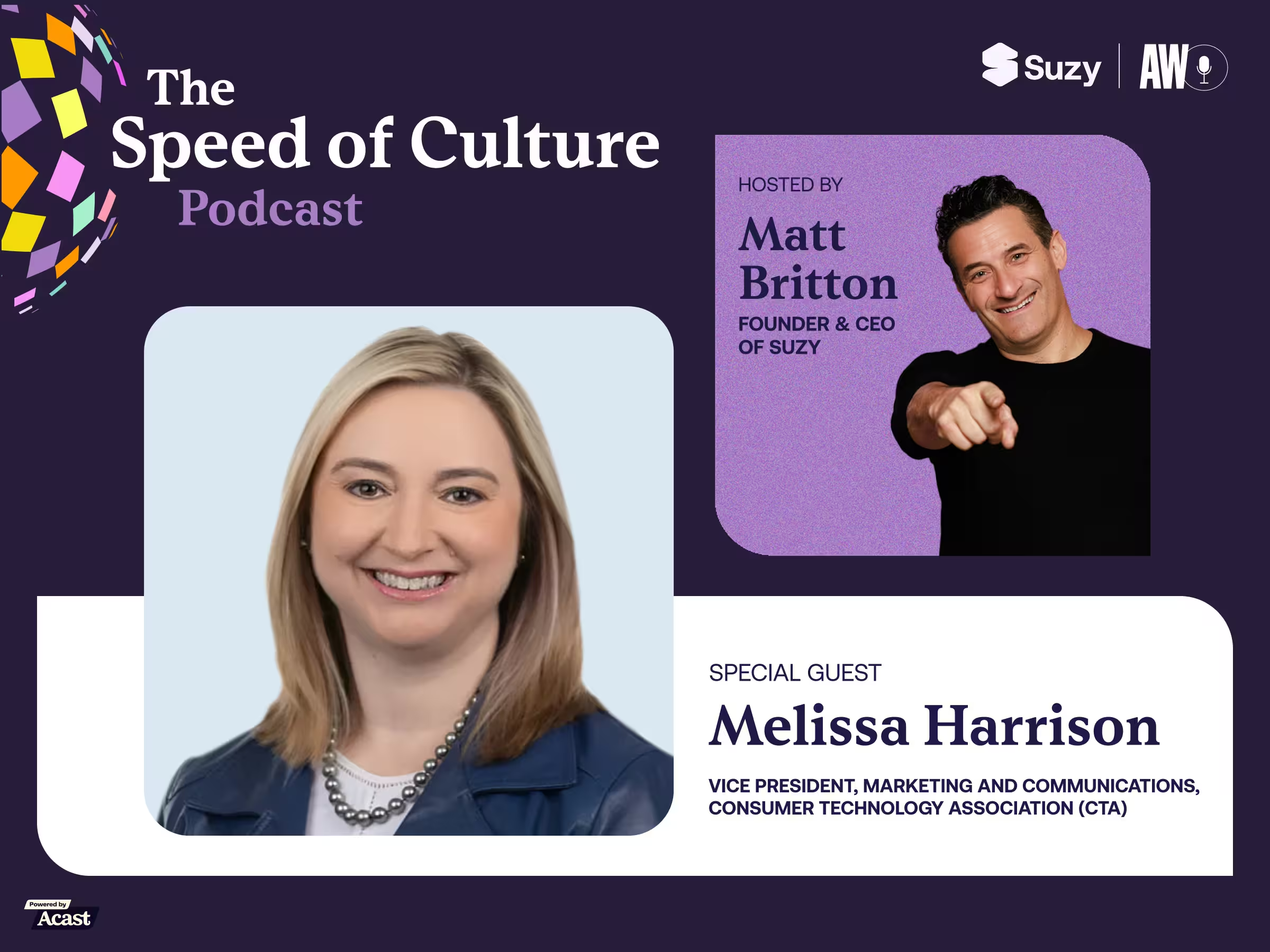

“You cannot replace the serendipity of bumping into someone on the show floor and having a conversation.” – Melissa Harrison
Technology moves fast, but progress rarely happens in isolation. It takes shared standards, coordinated policy, and moments where people come together to exchange ideas, test assumptions, and build trust. In a world shaped by remote work and digital tools, those moments matter more than ever. CES has become one of the few places where that kind of connection still happens at global scale.
In this episode of The Speed of Culture podcast, Melissa Harrison, Vice President of Marketing and Communications at the Consumer Technology Association (CTA), joins Matt Britton live from CES 2026 to unpack how the world’s largest technology convening continues to evolve. Melissa shares what most people never see behind CES, from year-round policy and standards work to the decisions that shape the show floor, the rise of creators, and why AI at CES 2026 marks a meaningful shift from conversation to real-world application.
Tune into the latest episode or read the transcript below to learn more. Here are some top takeaways:
CES is the tip of the iceberg
Most people experience CES as a moment in January. What Melissa explains early in the conversation is that CES sits on top of year-round work carried out by the Consumer Technology Association CTA.
CTA operates across policy advocacy, research, and standards that shape how technology functions globally. From accessibility initiatives to the standards that quietly govern everyday tools, this work rarely makes headlines. CES becomes the visible moment where those efforts converge.
Understanding this context reframes CES 2026 recap conversations. The show does not exist to introduce isolated products. It reflects systems already in motion and industries already changing.
Why CES is in Las Vegas and why January matters
CES does not happen in Las Vegas by tradition or convenience. Melissa breaks down why CES is in Las Vegas with practical clarity.
The show begins construction in December, takes weeks to build, spans 13 venues, and requires roughly 150,000 hotel rooms. No other city can support that level of infrastructure. January provides the only window when the city and convention spaces can accommodate a build of this scale.
CES exists where it does because logistics make it possible. The location supports the ambition.
From gadget show to industry crossroads
CES once carried the label of a gadget show. That framing no longer fits reality.
As Melissa explains, technology now lives inside everything. Cars function as devices. Homes operate as systems. Healthcare, mobility, retail, and enterprise rely on the same underlying technologies. CES reflects that convergence.
This shift explains why brands across sectors show up. CES becomes a live map of how industries overlap and why technology trade show trends increasingly center on collaboration rather than categories.
Marketing a global, two-sided ecosystem
Marketing CES starts long before anyone steps onto the show floor. Melissa describes CES marketing strategy as a constant balancing act between two distinct audiences: the people who come to experience the show and the companies who invest to exhibit. Each group arrives with different goals, timelines, and definitions of value, and none of them respond to generic messaging.
What draws a mobility executive will not move a digital health founder or an enterprise buyer. On top of that, CES speaks to a global audience shaped by local policy, trade dynamics, and geopolitical context. As a trade association, CTA must also clarify who it is and what it represents in markets where the line between government and industry looks very different.
The work comes down to precision. Knowing the audience well enough to speak to real interests, not assumed ones. Relevance becomes the reason people commit the time, travel, and attention to show up.
Creators changed the media playbook
CES has always been a media moment, but Melissa makes clear that the definition of media has shifted in a very real way. As the creator economy at CES grew, CTA realized that creators were showing up with completely different expectations. They were not there to sit in media lounges or wait for press briefings. They wanted to be on the show floor, close to the news, moving fast, filming live, and turning moments into content within minutes.
Rather than guessing what creators needed, CTA asked. They built a creator space, watched how it was used, gathered feedback in real time, then moved it directly onto the show floor. Brands soon wanted in too, not for visibility, but for conversation. The result treated creators as operators running businesses, not an extension of traditional media, reflecting how influence and storytelling now actually work.
AI moves from conversation to reality
AI has been part of CES for years, but AI at CES 2026 feels different because it shows up in physical form. Melissa describes this year as the point where AI moves out of slides and into the room. Attendees see physical AI, digital twins, humanoids, and autonomous systems operating in front of them, not as concepts, but as demonstrations.
CES becomes the place where companies choose to make news, bringing breakthroughs to the public at the earliest moment. What once felt speculative now feels present. The conversation shifts from what AI might do to what it is already doing. Innovation starts getting judged by experience and execution, not just ambition, changing how credibility is earned across the industry.
Why in-person connection still wins
Remote tools make coordination easier, but Melissa returns to what CES enables that screens never fully can. You cannot plan serendipity. CES creates conditions where people run across halls to greet partners they only see once a year, stumble into conversations on the show floor, and make decisions faster because trust forms face to face.
Exhibitors average dozens of meetings in a single week, compressing months of travel or virtual calls into a few days. Emotion, body language, and shared context do the work that video calls struggle to replicate. This is why CES continues to matter and why technology trade show trends still favor convening at scale when real relationships, partnerships, and outcomes are on the line.
What this means for leaders and builders
This episode offers more than a behind-the-scenes look at CES. It provides a practical lens on how innovation actually moves.
The lessons are clear:
- Foundational work matters as much as headlines.
- Relevance depends on understanding who you are speaking to.
- Creators and media operate by new rules.
- AI gains credibility when it becomes tangible.
- In-person connection still accelerates trust and progress.
For leaders navigating CES marketing strategy, evolving technology trade show trends, or preparing for what comes next after CES 2026, this conversation offers grounded perspective without hype.